The Polk Patio 200 is a solid, no-nonsense outdoor speaker pair that delivers genuinely good sound for a covered patio or pergola, provided you set realistic expectations about bass extension and placement. It is a Best Buy exclusive (or was, during its production run) and sits very close to the Polk Atrium 5 under the hood, sharing the same 5-inch polypropylene woofer, 0.75-inch aluminum dome tweeter, sealed mineral-filled enclosure, and rust-resistant aluminum hardware. Rated at 50 W RMS / 100 W peak into 8 ohms with a 90 dB sensitivity and a stated frequency range of 60 Hz to 25 kHz, it hits all the practical benchmarks you need for background-to-moderate party levels outdoors. If you already own a stereo receiver or a multi-zone amplifier and want a durable, easy-to-mount pair that actually sounds like music rather than a clock-radio, the Patio 200 is worth your attention.
polk patio 200 review: Outdoor Speaker Performance & Value

Who this review is for
This review is aimed at homeowners who are building or upgrading an outdoor living space and want a dedicated wired speaker solution rather than another Bluetooth portable. If you have a covered patio, a screened porch, a pergola, or a deck with some overhead protection and you already have or are willing to buy a small amp or A/V receiver, the Patio 200 is a genuinely practical option. It is also useful reading if you are deciding between the Patio 200 and the Atrium 5 (nearly identical), or comparing it to cheaper or pricier alternatives before committing. This review covers real construction details, sound performance based on verified user feedback and known spec analysis, weatherproofing limitations, installation practicalities, and honest value context.
At-a-glance specs
| Specification | Detail |
|---|---|
| Configuration | 2-way, sealed enclosure |
| Power handling (RMS / Peak) | 50 W / 100 W |
| Impedance | 8 Ω nominal |
| Frequency response | 60 Hz – 25 kHz |
| Sensitivity | 90 dB (1 W / 1 m) |
| Tweeter | 0.75" anodized aluminum dome |
| Woofer | 5" Dynamic Balance polypropylene cone |
| Cabinet material | Mineral-filled polypropylene (sealed) |
| Grille / bracket material | Rust-resistant powder-coated aluminum |
| Hardware | Stainless steel |
| Dimensions (H × W × D) | 10.31" × 6.75" × 6.69" |
| Weight (each) | 4.6 lb |
| Color options | White / Black |
| Sold as | Pair |
| Warranty | 1-year limited (speaker); Polk Atrium-family equivalent: 5-year limited on cabinet and drivers |
A note on the warranty: Polk's Atrium series carries a stated 5-year limited warranty on cabinets and drivers. Because the Patio 200 is a Best Buy-channel variant closely related to the Atrium 5, warranty terms at point of purchase may differ slightly, so confirm with your retailer before buying.
What the Polk Patio 200 actually is
Polk has long offered a range of outdoor speakers under the Atrium name, each sharing the same core design philosophy: a sealed, weatherproof cabinet built from mineral-filled polypropylene, Dynamic Balance drivers, and corrosion-resistant hardware designed to survive seasons of outdoor exposure. The Patio 200 sits in that same family but was sold exclusively through Best Buy, which is why you will find forum threads where users note the grilles, brackets, and driver specs of the Patio 200 and Atrium 5 appear nearly identical. It is not a budget knockoff; it uses the same driver and cabinet DNA. Think of it as Polk's midrange outdoor entry point packaged for a specific retail channel, comparable in tier to the Atrium 5 and positioned below the larger Atrium 6 and Atrium 8.
The 5-inch woofer class is Polk's sweet spot for compact outdoor installations. You get enough cone area to produce real midrange body and some upper-bass presence without the bulk and bracket load of a 6.5-inch or 8-inch driver. For most residential patios, this is exactly the right size tradeoff. The Patio 200 is a passive speaker, meaning it needs an external amplifier or receiver to drive it. This is not a Bluetooth or wireless product. That distinction matters, and we will cover it fully in the installation section.
Design, build, and aesthetics
The cabinet is molded from mineral-filled polypropylene, which is the right material choice for outdoor use. Unlike ABS or standard polypropylene, the mineral fill increases rigidity and reduces resonance, which directly benefits speaker coloration. It also resists UV degradation and moisture absorption better than wood-composite cabinets you sometimes see on cheaper outdoor speakers. The sealed enclosure design (no port) means there is no opening for insects, moisture, or debris to enter the cabinet interior, which is a meaningful long-term durability advantage over ported outdoor speakers.
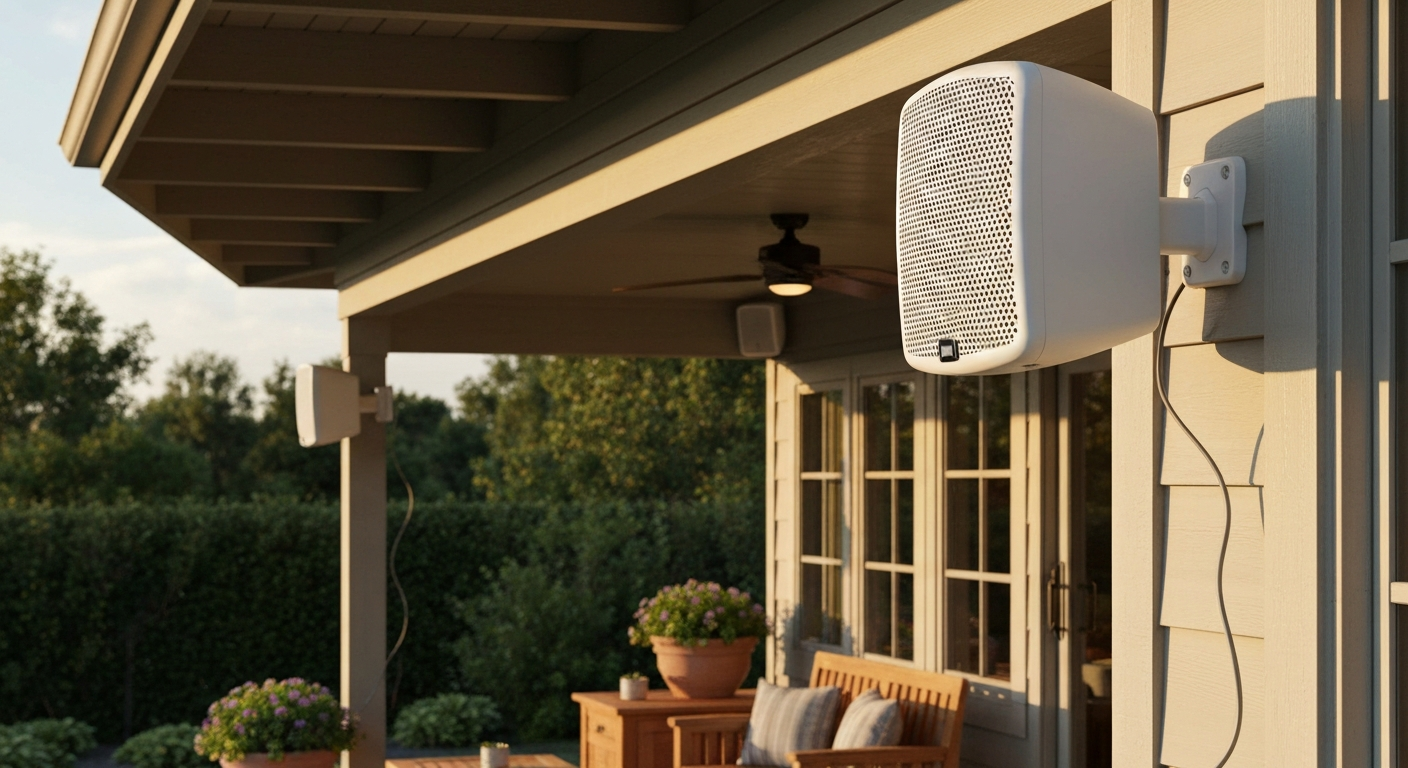
The powder-coated aluminum grille protects the drivers without adding significant weight or introducing the audio artifacts of some cheaper plastic grilles. Stainless steel hardware throughout (screws, inserts) resists rust and electrochemical corrosion that can occur when dissimilar metals contact each other in humid or coastal environments. The swivel bracket is also powder-coated aluminum and allows for horizontal or vertical orientation with angle adjustment, which is practically important for aiming the speaker correctly at a listening area rather than just pointing it straight out from a wall.
Available in white or black, the Patio 200 is unobtrusive on most siding and trim colors. It is not a design statement piece, and Polk makes no attempt to market it as one. It looks like what it is: a competent outdoor speaker that prioritizes function over form. For most patios, that is exactly what you want, since the speaker should complement the space rather than compete visually with your furniture or landscaping.
Sound performance: real-world listening impressions
No independent lab has published calibrated frequency response or THD measurements for the Patio 200 specifically. Audioholics, RTINGS, and What Hi-Fi have extensive test benches but no documented Patio 200 measurement article exists in public search results as of this review. See Audioholics, Product Reviews (search source for measurement reviews) for an example of a measurement-focused review repository used when checking for instrumented tests Audioholics — Product Reviews (search source for measurement reviews). What we have is a well-understood set of specifications, a close genetic relationship to the Atrium 5 (which has been reviewed more widely), and a substantial body of verified user feedback from Best Buy purchasers. The impressions below synthesize that material alongside what the specs tell us about likely performance.
Bass
The 60 Hz lower limit is a measured-at-useful-output figure for a sealed 5-inch driver, which is honest. You are not getting meaningful sub-bass or the kind of chest-feel you associate with a subwoofer. What you do get is clean upper bass (80–150 Hz range) that carries acoustic guitar body, piano left-hand notes, and the punch of a kick drum at moderate levels. User feedback consistently mentions that bass is adequate and clean rather than deep, which is exactly what the physics of a sealed 5-inch cabinet predicts. If your listening consists of pop, rock, acoustic, jazz, or background party music, this is not a problem. If you want thumping outdoor bass, you need to add a subwoofer or choose a larger driver.
Mids and highs
Polk's Dynamic Balance driver technology uses finite element analysis to minimize resonance modes in the cone, and the polypropylene cone material adds inherent damping. The result, consistent across the Atrium family and reported by Patio 200 users, is a smooth, grain-free midrange that handles vocals and acoustic instruments without harshness. The 0.75-inch anodized aluminum dome tweeter extends usably to 25 kHz and typically crosses over in the 3–5 kHz range in Polk's outdoor designs. Users describe the high end as detailed and bright without being fatiguing, which aligns with a well-damped aluminum dome. At typical outdoor background levels, the Patio 200 sounds considerably more refined than you might expect from a speaker at this price.
Volume and clarity
At 90 dB sensitivity with 50 W RMS handling, these speakers will get genuinely loud from a modest amplifier. A 20–30 watt per channel receiver will drive them to levels appropriate for a medium patio without strain. At higher volumes there is some compression and the bass tightens further, but distortion does not become objectionable at typical outdoor party levels. Clarity holds well at moderate volume: instruments remain separated, stereo imaging (within outdoor listening limits) is present, and music does not collapse into a wall of sound. For covered patios and pergolas at 200–400 square feet, a pair of Patio 200s driven by a reasonable amplifier will fill the space comfortably.
Weatherproofing and long-term durability
Polk does not publish a specific IEC 60529 IP rating for the Patio 200. This is important context. An IP rating requires a documented test to IEC 60529 methodology by the manufacturer or a qualified test lab, certifying resistance to defined levels of solid particle and water ingress. Without a published IP code, you cannot make direct comparisons to products like outdoor Bluetooth speakers that do carry IP67 or IPX5 ratings. What Polk does document for the closely related Atrium series is a set of military and ASTM environmental test references: ASTM D5894 cyclic salt fog and UV exposure, MIL-STD-810 immersion, and MIL-STD-883 method 1009. ASTM D5894 is the standard practice for cyclic salt‑fog and UV exposure of painted metal used to simulate combined salt fog and UV aging for painted/coated metals ASTM D5894 is the standard practice for cyclic salt‑fog and UV exposure of painted metal used to simulate combined salt fog and UV aging for painted/coated metals.. 8 for salt/corrosion resistance. These are rigorous industrial test regimes, and they suggest the Atrium-family construction (which the Patio 200 shares) was validated against serious environmental stress, even if no IP badge appears on the box.
In practice, the sealed mineral-filled polypropylene cabinet resists moisture, UV, and temperature cycling better than most entry-level outdoor speaker designs. The stainless steel and powder-coated aluminum hardware prevents the rust streaks and bracket failures that plague cheap outdoor speakers within a season or two. Long-term verified user feedback from Best Buy reviews includes multiple accounts of Patio 200 pairs surviving four to seven years of outdoor installation in various US climates with no structural failure, which is a meaningful real-world endorsement.
The main durability caveat is direct, prolonged UV and rain exposure. Polk's own Atrium documentation recommends siting speakers under eaves, overhangs, or covered structures for maximum service life. This is not a cop-out; it reflects genuine material science. Even UV-stabilized polypropylene will chalk and discolor faster when pointed directly at the sky in high-UV climates. If you are planning a fully exposed installation on a sun-drenched open deck, you should either protect the speakers with a quality outdoor furniture/equipment cover when not in use, or consider a marine-grade speaker built specifically for unprotected exposure. For recommendations on durable grill and equipment covers, see our Patio Armor grill cover review. For the vast majority of patio installations, under an eave or pergola, the Patio 200's weather resistance is more than adequate.
Installation, placement, and mounting
The Patio 200 ships with a swiveling wall-mount bracket already designed into the enclosure. Installation is a two-screw wall mount in most cases: find your stud or use appropriate masonry anchors, attach the bracket, run your speaker wire, and connect to the binding posts on the rear of the enclosure. The binding posts accept bare wire, banana plugs, or spade connectors. Polk recommends 16-gauge wire for runs up to approximately 50 feet and 14-gauge for longer runs to avoid resistance losses that would reduce effective amplifier power delivery. For most residential patios, 16-gauge CL2-rated (in-wall rated) or direct-burial outdoor speaker wire is the right choice.
Power source and connectivity: this is a passive wired speaker. You need an amplifier or A/V receiver with speaker output terminals. It is not compatible with Bluetooth, Wi-Fi, or any wireless audio protocol natively. If you want wireless convenience, you would need to add a separate Bluetooth receiver or use a product like a Sonos Amp driving the Patio 200 passively, which is a popular and capable combination. Some users run these from multi-zone A/V receivers with a dedicated outdoor zone. The 8-ohm nominal impedance is safe for any standard receiver or stereo amplifier rated for 8-ohm loads.
Pairing and stereo setup: these are sold as a pair, and standard stereo placement (left/right separation of roughly 6–10 feet for typical patio seating) gives you a defined stereo image. For background music at a larger gathering, a wider separation is fine since you are not trying to create a critical listening position outdoors. If you are running a single zone to a large deck, consider whether a second pair of speakers in a series-parallel configuration (consult your amplifier's minimum impedance spec) would serve coverage better than one pair at high volume.
Placement diagrams and patio layout guidance
Getting placement right matters more outdoors than indoors because there are no room boundaries to help distribute sound. The following guidance covers three common patio sizes and mounting orientations.
Small covered patio (up to 150 sq ft)
Mount both speakers on the same wall or on the two walls that meet at the primary seating corner. Aim them slightly downward (10–15 degrees) toward the seating area using the swivel bracket. A separation of 6–8 feet between the two speakers is sufficient. Wire can typically be run along the eave trim or tucked behind the soffit. At this scale, a 20-watt-per-channel amplifier is more than sufficient. Sound coverage will be even and clear throughout the space with minimal need for high volume settings.
Medium patio or pergola (150–350 sq ft)
Mount the speakers on opposite ends of the long axis of the space, approximately 8–12 feet apart, at a height of 8–10 feet, angled 10–20 degrees downward. This creates overlapping coverage zones that keep volume even across the seating and dining areas. Vertical orientation (tweeter on top) is preferred at this height for optimal dispersion of the high frequencies toward the listening plane. For a pergola without solid walls, consider mounting on the posts rather than a wall to get the speakers closer to the seating zone rather than at the perimeter. Run wire through conduit attached to the post if aesthetics matter.
Large deck or extended outdoor area (350–600 sq ft)
A single pair of Patio 200s will struggle to fill a large open deck evenly without running at high volumes, which increases distortion and listening fatigue. The better solution is two pairs: mount one pair at the house end of the deck and a second pair at the far end, both aimed inward and downward, run from a multi-zone amplifier or a bridged dual-zone receiver. Keep each pair's volume at a moderate level for a more natural and even distribution. Wiring for this layout typically means running two independent speaker wire runs from your amplifier location, which is worth planning before you install any trim or decking. For a single pair in a large space, place both speakers on the house wall centered on the deck width, at 10–12 feet height, aimed out and slightly downward, and accept that coverage at the far end of the deck will be lower-level background audio rather than a full listening experience.
Mounting orientation tips
- Vertical orientation (tweeter above woofer) is preferred at heights of 8 feet and above because it delivers high-frequency dispersion toward the horizontal listening plane.
- Horizontal orientation is acceptable for under-eave mounting at 7 feet or lower where the speaker is closer to ear level.
- Always angle the speaker toward the primary seating zone, not parallel to the mounting surface, using the swivel bracket's adjustment range.
- Avoid pointing speakers directly into prevailing wind or rain directions; even with a sealed enclosure, avoiding direct water impact prolongs finish life.
- Mount on the structure side (house wall, pergola post) rather than on a fence or freestanding post where vibration and instability can affect both sound quality and bracket longevity.
- Leave at least 6 inches of clearance from the enclosure back to the wall for heat dissipation during extended high-volume use.
Maintenance, warranty, and common failure modes
Routine maintenance for the Patio 200 is minimal. Wipe the cabinet and grille with a damp cloth seasonally to remove pollen, bird droppings, and grime that can accelerate UV aging of the cabinet surface. Inspect binding post connections annually for corrosion, especially in coastal or high-humidity climates. If you see white oxidation on the terminals, clean with a cotton swab and electrical contact cleaner, then apply a small amount of dielectric grease. Check the bracket mounting screws once a year since vibration can gradually back them out.
The most common failure mode reported in user reviews is tweeter damage from sustained high-power operation or lightning-induced voltage spikes through the speaker wire run. Both are avoidable: do not run the speakers at or near full amplifier power for extended periods, and consider installing an in-line surge protector or lightning arrester on outdoor speaker wire runs in thunderstorm-prone regions. Cabinet and bracket failures are rare based on available user feedback, validating the construction quality of the sealed polypropylene and aluminum hardware combination.
If you plan to store the speakers during winter or during a period of property vacancy, removing them and storing indoors is the safest option. If leaving them installed year-round in a harsh climate, use a quality outdoor speaker cover or wrap them in breathable weatherproof material. Related patio protection products (furniture protectants, storage solutions, and weatherproof covers for adjacent outdoor equipment) can round out your full outdoor setup's protection strategy. For related products, see Suncast patio storage and prep station reviews for options on protective storage and prep solutions that complement outdoor speaker installations. For more on durable patio gear, see PermaSteel patio cooler reviews for real-world feedback on outdoor-rated coolers and covers. For buying guidance on weatherproof storage options, see our patio storage box reviews for recommendations and comparisons. For a recommended protective product, see 303 patio furniture protectant reviews for a well-regarded option to protect outdoor cushions and upholstery.
Pricing and value
The Patio 200 was typically sold in the $80–$130 range as a pair during its primary retail availability at Best Buy. At that price point it represents strong value for a sealed, all-weather speaker with genuine Polk driver quality. The Atrium 5, its closest sibling, currently retails in the $100–$150 range as a pair depending on promotions. If you find Patio 200 units available new or near-new on the secondary market, anything under $100 for a pair in good condition is a very good deal. The value proposition breaks down only if you need Bluetooth or wireless capability, in which case you are paying for a passive speaker and then separately for an amplifier and wireless source, which changes the total cost calculation.
How it compares to the alternatives
| Speaker | Driver Size | Power (RMS) | Sensitivity | Key Differentiator | Approx. Price (Pair) |
|---|---|---|---|---|---|
| Polk Patio 200 | 5" | 50 W | 90 dB | Sealed PP cabinet, stainless hardware, Best Buy exclusive | $80–$130 |
| Polk Atrium 5 | 5" | 50 W | 89 dB | Near-identical design, widely available, Polk direct warranty | $100–$150 |
| Polk Atrium 6 | 6.5" | 80 W | 90 dB | More bass extension, better for larger spaces | $130–$180 |
| Klipsch AW-650 | 6.5" | 75 W | 94 dB | Higher sensitivity, horn-loaded tweeter, richer output | $180–$250 |
| Yamaha NS-AW150 | 4" | 30 W | 88 dB | Budget entry point, smaller driver, lighter bass | $50–$80 |
| OSD Audio AP670 | 6.5" | 100 W | 90 dB | Larger driver, coaxial option available, strong value | $120–$160 |
For most homeowners at the Patio 200's price point, the Polk Atrium 5 is the most direct alternative and often the better purchase simply because it is easier to find new with a clear warranty and Polk customer support. The Atrium 6 is worth the step up if your patio is larger than 300 square feet or if you want more bass presence without a subwoofer. The Klipsch AW-650 is a noticeable step up in efficiency and volume ceiling but costs roughly twice as much. The Yamaha NS-AW150 is a legitimate budget alternative if you are equipping a small balcony or secondary listening area and do not want to spend more.
What users actually say
Verified Best Buy purchasers consistently highlight three things: sound quality that exceeds expectations at the price, installation ease thanks to the pre-attached swivel bracket, and durability over multiple years of outdoor use. The most common complaint is that bass feels thin at higher volumes, which is an honest limitation of a 5-inch sealed driver outdoors and not a product defect. A small number of users report grille discoloration after prolonged direct sun exposure, reinforcing Polk's own guidance about covered installation. Negative reviews mentioning premature failure almost always involve fully exposed mounting without overhead cover, or running the speakers well past their power rating for extended periods.
Pros and cons at a glance
- PRO: Sealed mineral-filled polypropylene cabinet is genuinely durable outdoors
- PRO: Stainless steel and powder-coated aluminum hardware resists corrosion credibly
- PRO: 90 dB sensitivity means adequate volume from modest amplifiers
- PRO: Dynamic Balance polypropylene cone and aluminum dome tweeter produce a refined, non-harsh sound
- PRO: Clean midrange and controlled high end suit vocals and acoustic music well
- PRO: Pre-attached swivel bracket makes installation straightforward
- PRO: Strong value per-dollar compared to similar outdoor speaker designs
- CON: No published IP rating — weatherproofing is real but not standardized-certified
- CON: Bass extension is limited below 80 Hz, which is inherent to the sealed 5-inch design
- CON: Passive design requires a separate amplifier and wiring run
- CON: Best Buy-exclusive channel limits new availability now that it is discontinued
- CON: Direct sun exposure accelerates cabinet and grille aging despite UV-resistant materials
Buying checklist
- Confirm you have or are willing to buy a compatible amplifier or A/V receiver with 8-ohm speaker outputs.
- Measure the distance from your amp location to the intended speaker mounting position to determine speaker wire gauge needed (16 AWG for under 50 feet, 14 AWG for longer runs).
- Verify your mounting surface (stud, masonry, or composite) and obtain appropriate fasteners before installation day.
- Assess whether your planned installation location is covered by an eave or overhang; if not, plan for seasonal removal or a protective cover.
- Check regional availability: the Patio 200 is discontinued as a new product, so confirm condition and warranty status when buying from secondary channels.
- If buying for coastal or high-humidity climates, budget for annual binding post inspection and dielectric grease treatment.
- Consider whether a companion subwoofer is needed if bass performance is a priority for your music listening habits.
- Plan your wire routing in advance, especially if running through walls, eaves, or conduit on pergola posts.
The final verdict
Buy the Polk Patio 200 if you want a durable, genuinely musical outdoor speaker pair at a fair price and you are comfortable with a wired, passive setup. The sealed polypropylene cabinet, aluminum hardware, and Polk's Dynamic Balance drivers make this a speaker that sounds better than its price suggests and holds up better than many budget outdoor alternatives. Its limitations are honest ones: limited deep bass, no wireless capability, and best-practice advice to install it under cover. For a covered patio or pergola with a dedicated amp and a solid wire run, it remains one of the more sensible outdoor speaker investments in its class.
Skip it if you need Bluetooth convenience, plan a fully exposed installation in a high-UV coastal environment, or want serious bass output without adding a subwoofer. In those cases, look at the Polk Atrium 6 for more bass headroom, or the Klipsch AW-650 if budget allows for genuinely higher sensitivity and output. And if you are building out the rest of your patio space alongside your audio setup, do not overlook the details that affect your gear's longevity: protective covers for outdoor electronics and furniture, quality storage solutions for seasonal equipment, and patio furniture protectants for adjacent pieces all extend the life of your investment alongside the speakers themselves. For guidance on complementary patio gear and outdoor entertaining solutions, see Keter Patio Cooler and Beverage Cart reviews for buying, maintenance, and durability insights. For recommendations on durable outdoor furniture, covers, and protection products that pair well with your Patio 200 setup, see happy grill patio furniture reviews.
FAQ
What primary technical specs and documentation should I collect to verify Polk Patio 200 claims?
Collect the manufacturer’s archived product page and spec sheet (power ratings, impedance, sensitivity, driver sizes, frequency response, dimensions, weight), owner’s manual (materials, mounting hardware, installation guidance, stated warranty), and retailer product pages (Best Buy) for packaging/marketing copy and verified customer reviews. Save screenshots/URLs and note archival timestamps to document changes.
Which objective acoustic measurements are required to assess sound performance (bass, mids, highs, volume, clarity)?
Measure on-axis frequency response (20 Hz–20 kHz) with a calibrated microphone (UMIK‑1 or pro mic) and REW or AP analyzer; measure maximum linear SPL using AES75 noise procedure; measure THD vs. frequency and power with an Audio Precision or equivalent; measure impedance curve and sensitivity (1W/1m) per IEC 60268‑5. Provide measurement setup details (mic distance, room/anechoic conditions, gating/windowing).
What test equipment and standards should be used for objective testing?
Use an IEC‑compliant sound level meter (Class 1 or 2) for SPL, a calibrated measurement microphone (UMIK‑1, Earthworks), and a measurement analyzer (Audio Precision APx or REW + soundcard). Follow IEC 60268‑5 for loudspeaker measurements and AES75 for max linear SPL. Calibrate gear and report calibration dates.
How should real‑world listening tests be conducted and documented?
Use a controlled listening checklist: multiple musical genres, dialogue tracks, and real‑world outdoor playback material. Test at typical patio distances (3–6 m) and multiple placement scenarios. Use at least two independent listeners with notes on impressions (bass extension, mid clarity, treble detail, imaging, distortion, subjective max volume). Record blind A/B comparisons against a reference speaker if possible and report listener demographics/experience.
Which weatherproofing and durability evidence is necessary?
Request or cite manufacturer test claims (ASTM D5894, MIL‑STD‑810, MIL‑STD‑883) and the owner’s manual materials list (enclosure material, grille/bracket metals, hardware). Perform salt‑spray/corrosion inspections on long‑term used units if available, document UV fading, water ingress checks, and IP rating evidence (if manufacturer claims an IP rating, ask for test reports or lab certification per IEC 60529). Collect long‑term user reports of failures.
What installation and placement tests should be performed?
Document mounting options: bracket hardware, tilt/swivel adjustment, wiring routing, and tightness. Test ease of wiring with common cable types (18/16 AWG), measure effective coverage area at different mounting heights/angles, and produce placement diagrams for common patio layouts. Note compatibility with multi‑zone amps, transformers (for low‑voltage systems), and powered/active setups.
Suncast Patio Storage and Prep Station Reviews: Worth It?
Suncast patio storage and prep station reviews: compare models, real performance, pros cons, weather durability, setup t