
Patio furniture liquidators can be worth it, but only if you go in with clear expectations about what you're actually buying. The deals are real: liquidators like the Dallas-based Patio Furniture Liquidators genuinely do buy truckloads of overstock, closeouts, discontinued lots, and customer returns directly from manufacturers, then pass savings of 60 to 70 percent off retail to move volume fast. But that same model is exactly why reviews are full of complaints about missing parts, shifting delivery timelines, and limited recourse when something goes wrong. Whether it's a smart buy depends heavily on which category you're shopping, how flexible your timeline is, and whether you know how to read the reviews before you hand over your money. To make sense of patio furniture liquidator reviews, focus on recurring issues like shipping damage, cushion fading, and return deadlines before you order.
Patio Furniture Liquidators Reviews: How to Decide Wisely


What patio furniture liquidators are and how their deals actually work
Liquidators sit in a specific spot in the supply chain. They're not retailers in the traditional sense. They buy distressed inventory, which means overstock that a manufacturer couldn't move through normal channels, closeout lines being replaced by new models, cancelled retailer orders, and sometimes customer returns that have been inspected and repackaged. The business model, as Patio Furniture Liquidators of Dallas describes it publicly, is buying by the truckload and selling to the public at deep discounts to move volume quickly. That's a legitimate and often genuinely useful business, but it comes with structural quirks that explain a lot of what you read in reviews. If you want to narrow down what to expect from an anmutig patio furniture review, focus on the same details like material quality, cushion performance, and how shipping damage is handled patio furniture reviews.
First, inventory is not predictable. What's available today may be gone tomorrow, and restocking the exact same piece isn't guaranteed. Second, because the business is built on moving product fast, customer service infrastructure is typically leaner than at a dedicated retailer. Third, condition varies. New overstock is factory-fresh. Discontinued lots are usually fine but may lack the latest material upgrades. Returns are the wild card because condition depends entirely on how well the previous buyer packed and returned the item. When you see reviews mentioning missing hardware, surface scratches, or torn cushion packaging, that's usually the return pipeline showing itself.
How to actually read patio furniture liquidator reviews

The BBB profile for Patio Furniture Liquidators of Dallas shows a B+ rating with 5 complaints filed and no accreditation. On the Patio Furniture Liquidators listing snippet on Yahoo Local, the business review section aggregates star ratings and review excerpts that reflect buyer-expectation issues like lead-time changes or missed timelines blank" rel="noopener noreferrer">Yahoo Local listing snippet review section that aggregates star ratings and excerpts. That combination tells you something useful: the volume of complaints is low relative to total transactions, but the complaint content matters more than the score. A B+ from the BBB with unresolved delivery promise issues is a different story than a B+ from a business with spotless follow-through. Dig into the actual complaint text before you weigh the letter grade. A BBB customer review dated 09/08/2023 for Patio Furniture Liquidators of Dallas describes missing pieces after the seller promised about 2 to 3 weeks, with delivery-time promises repeated as of Sep 7 blank" rel="noopener noreferrer">BBB customer review dated 09/08/2023 describes missing pieces.
Rating signals worth your attention
- Shipping damage frequency: If more than one or two reviewers mention crushed boxes, bent frames, or cracked resin, that's a pattern, not a fluke.
- Missing parts mentions: A single complaint could be a warehouse error. Multiple reviewers citing missing hardware or incomplete sets points to a systemic packaging or inventory problem.
- Response time and resolution: Look at whether the seller actually resolved issues, not just whether they replied. A canned apology reply is different from a confirmed replacement shipment.
- Long-term durability comments: Reviews posted 12 to 18 months after purchase that mention rust streaks, fading cushions, or frame wobble are the most valuable quality signals you'll find.
- Delivery timeline accuracy: Liquidators often quote 2 to 3 week delivery windows but reviews frequently show slippage. One BBB reviewer described repeated promises with still-missing pieces as of September 2023, weeks after the original estimate.
Red flags that should make you pause

- Vague warranty language: "Free warranties" offered "while supplies last" or as a "limited time" add-on is marketing, not a guarantee. Press for exact warranty terms in writing before purchasing.
- No model number or SKU in the listing: Without a specific model identifier, you can't verify specs, find replacement parts, or cross-reference reviews from other sources.
- Reviewers who can't get a human response: If multiple people mention phone calls going unanswered or emails bouncing, that's a serious operational concern for post-sale support.
- Overwhelmingly generic 5-star reviews with no detail: These are often unreliable. Useful positive reviews describe specific assembly steps, dimensions, or comfort experience, not just "love it!"
What you can safely ignore
Ignore single reviews complaining about minor cosmetic issues on items that were clearly discounted as-is. Ignore complaints about color looking slightly different on screen than in person, since that's true of every online furniture purchase. And treat extreme one-star reviews about shipping carrier delays separately from the seller's own performance. The relevant review content is always about what happens after the delivery driver leaves: assembly experience, part completeness, and how the furniture holds up through the first season.
Shipping, delivery, returns, and warranty: what reviews keep surfacing
Shipping is the biggest operational risk with liquidators, and it shows up consistently in review content. Liquidators typically use freight carriers or white-glove third-party delivery for large items, which introduces handoffs where damage can occur. Unlike big-box retailers with dedicated logistics networks, a liquidator moving truckloads of mixed inventory doesn't always have the same control over final-mile handling. If you're ordering a large sectional or a full dining set, get clarity on whether the delivery is curbside, threshold, or room-of-choice before you commit, because a 200-pound crate at your driveway is a very different experience than inside delivery.
Returns are where the liquidator model gets genuinely uncomfortable. Most liquidators have return policies that are narrower than mainstream retailers, often requiring you to report damage within 48 to 72 hours of delivery, photograph every piece, and sometimes cover return freight on large items yourself. Read the return window policy before purchasing, not after. If the policy is buried or vague, that's a signal about what your experience will be if something arrives wrong.
Warranty coverage at liquidators varies dramatically. When a business markets "free warranties" with limited-time or while-supplies-last language, that's a promotional framing, not a standard structural warranty. Ask directly: what does the warranty cover, for how long, and who handles claims? Is it backed by the original manufacturer or by the liquidator itself? Manufacturer warranties may or may not transfer to liquidator sales depending on the brand's policy, so confirm that upfront if the warranty matters to you.
What reviews actually tell you about furniture quality
Reviews are most useful as a proxy for material quality when you can't physically touch the piece. The details reviewers volunteer without being asked, things like "the frame felt heavier than expected" or "the cushions went flat after one summer" or "the powder coat started chipping at the weld points," give you a clearer picture than any spec sheet.
Frame material: aluminum vs. steel

Aluminum frames don't rust, which is the single most important quality factor for outdoor furniture that sits exposed to rain, dew, and humidity. Steel frames are heavier and often less expensive, but even powder-coated steel will develop rust at scratches, welds, and joints over time, especially in coastal or humid climates. If reviews on a liquidator listing mention rust appearing within the first year or two, it's almost certainly a steel frame piece, and that's worth knowing before you buy. Aluminum costs more upfront but typically pays back in longevity.
Cushions, fabric, and UV performance
Cushion quality is the second most common quality complaint across all patio furniture reviews, not just liquidators. Look for reviews that specifically mention Sunbrella or solution-dyed acrylic fabric because those materials genuinely resist fading for 5 or more years. Polyester-fill cushions that aren't solution-dyed will start fading and developing mildew within one to two seasons in most climates. If a liquidator listing doesn't name the fabric type or cushion fill density, that's a gap worth filling before you buy. Call and ask for the fabric code or cushion specification.
Welds, joints, and finish coatings
Weld quality is something reviewers notice when it fails but rarely mention when it's good. Complaints about wobbly joints after one season, or visible gaps in the frame where sections connect, signal thin-walled tubing or weak welding rather than structural aluminum construction. A well-built outdoor frame uses thick-walled aluminum, fully welded (not bolted) main joints, and a powder coat applied over a primer layer, not sprayed directly onto bare metal. If a review describes a frame that rattled or flexed during assembly, that's construction feedback, not just an assembly complaint.
Liquidators vs. mainstream brands: is the savings worth the tradeoff?
Here's how the value math actually plays out across the spectrum, from budget-line brands to premium retailers.
| Buying Channel | Typical Price Range | Construction Quality | Warranty & Returns | Long-Term Durability |
|---|---|---|---|---|
| Liquidator (e.g., Patio Furniture Liquidators) | 60-70% off original retail | Varies widely by source lot; aluminum and steel mixed | Narrow return windows, warranty terms vary; confirm before buying | Depends entirely on the original brand in the lot |
| Budget retailers (Costway, Temu-style) | Low baseline price | Mostly steel frames, thin cushions, basic powder coat | Limited warranty, minimal customer service infrastructure | 1-3 seasons typical before rust or fade issues emerge |
| Mid-range (Home Depot, Wayfair, Overstock) | Mid price, frequent sales | Mix of steel and aluminum, improving cushion quality | Easier returns, standard 1-year warranty common | 3-5 seasons with proper care and covers |
| Premium (West Elm, Pottery Barn, Frontgate) | Full retail, high price point | Cast or extruded aluminum, Sunbrella or equivalent, heavy frames | White-glove returns, multi-year warranties, replacement parts available | 7-15 years with basic maintenance in most climates |
Where liquidators genuinely win is when the lot they're moving is from a mid-range or premium manufacturer. Buying a discontinued Frontgate or Pottery Barn line through a liquidator at 65 percent off retail is a legitimately excellent deal because you get premium-level construction at near-budget pricing. Where liquidators are a poor value is when the discounted piece is a budget-brand item that was already priced at the low end of the market, because then you're paying less for something that was already built to a low standard and now comes with fewer customer service options.
This is why it's critical to identify the original brand or manufacturer of the liquidated inventory before purchasing, not just the liquidator's price. The deal isn't the discount percentage. The deal is what you're getting at that discount.
Matching your category to what reviews say
Outdoor dining sets
Dining sets from liquidators tend to review well when the frames are aluminum and the lot is from a recognizable brand. The main complaints are around chair wobble (a frame gauge issue), cushion comfort at the seat edge (a foam density issue), and tabletop durability for glass tops. If you see consistent complaints about glass top cracking during delivery, that's a packaging problem specific to that liquidator's shipping setup, not necessarily a product flaw.
Sectionals and deep-seat loungers
This is the highest-risk category for liquidator purchases. Sectionals are large, heavy, and complex to ship without damage. They also require the most assembly, which means more opportunity for missing hardware to derail the whole setup. Reviews for liquidator sectionals almost always mention assembly time (expect 3 to 5 hours for a full set), and the complaints about missing bolts or misaligned frame sections are more common here than in any other category. If you buy a sectional through a liquidator, photograph every component immediately on delivery before assembly, and inventory the hardware pack against the parts list.
Swings and hanging chairs
Swings are a category where the original brand matters enormously for safety, not just aesthetics. Weight ratings, chain or rope quality, and frame anchoring are structural concerns that reviews don't always address in useful detail. When buying a swing through a liquidator, confirm the weight capacity and the hardware specification before purchasing. Reviews for swings at liquidator prices tend to focus on comfort and appearance more than structural integrity, which means you have to ask the technical questions yourself rather than relying on review content alone.
Outdoor covers
Covers are a category where liquidators can offer genuinely good value with minimal risk, because covers are lightweight, easy to ship, and condition is easy to verify on delivery. The reviews that matter most for covers are about fit accuracy and material weight (measured in denier; 600D polyester or higher is a meaningful durability indicator), water resistance (look for PVC backing or sealed seams), and UV resistance. A cover that doesn't fit perfectly is nearly useless for protecting a sectional from a heavy rain, so make sure you can confirm dimensions against your specific furniture model before buying a liquidated cover.
Your practical checklist before buying from a patio furniture liquidator
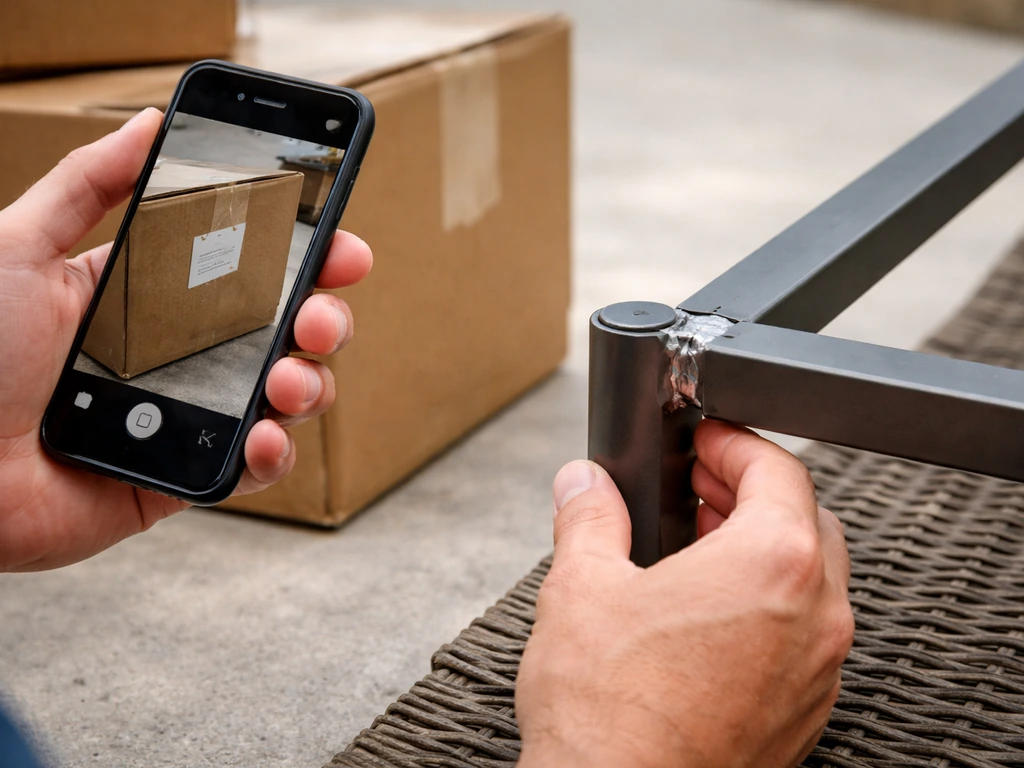
These are the concrete steps that separate buyers who are happy with their liquidator purchase from buyers who leave frustrated reviews on the BBB. If you’re specifically comparing different repair and restoration options for patio furniture, make sure your research includes patio furniture rehab reviews before deciding what to do next.
- Identify the original manufacturer and model number. Ask the liquidator directly if it's not in the listing. Without this, you can't cross-reference independent reviews, verify specs, or find replacement parts later.
- Request the exact material specifications: frame material (aluminum or steel), cushion fabric name or code, cushion fill thickness (4 inches or more is a meaningful benchmark for deep-seat comfort), and finish type.
- Confirm the warranty terms in writing before placing your order. Ask: what does it cover, for how long, is it the manufacturer's warranty or the liquidator's own coverage, and what's the claims process?
- Read the return policy in full and note the damage reporting window. Most liquidators require damage reporting within 48 to 72 hours of delivery, so plan to inspect everything immediately.
- Ask about delivery specifics: Is it curbside, threshold, or white-glove? Will you need help unloading? Is freight insurance included if the carrier damages the item?
- Photograph every carton before opening, every component as you unpack, and the hardware pack before assembly. This documentation is your only leverage if parts are missing or items arrive damaged.
- Inventory the hardware against the parts list before you begin assembly. Do not start assembling until you've confirmed every bolt, washer, and cap is present.
- Ask what the lead time realistically is, not the stated estimate. Request the name of the carrier and whether you'll get a tracking number. Reviews consistently flag that stated 2 to 3 week timelines can slip without proactive communication from the seller.
- Check the BBB profile and any Yelp or Google reviews, but focus on review text, not star ratings. Look specifically for comments about responsiveness after a problem occurred, not just the initial purchase experience.
- If you're buying a cover, measure your furniture precisely (length, width, height, and arm height) and compare against the listed cover dimensions before ordering. A 2-inch mismatch on a large sectional means the cover won't seal correctly in wind or rain.
Buying from a patio furniture liquidator is genuinely worth it in the right circumstances, specifically when the discounted inventory originates from a mid-range or premium manufacturer, when you have flexibility on delivery timing, and when you do the upfront verification work that most buyers skip. If you want patio festival furniture reviews, prioritize listings that clearly spell out material details and shipping or return expectations before you buy patio furniture liquidator purchase. If you want a clear patio furniture review before you buy, use these checks to judge quality, delivery risk, and what you can realistically expect after purchase patio furniture liquidator. Where it becomes a bad deal is when you treat the discount percentage as the whole story and skip asking about the original brand, the warranty specifics, and the return window. Reviews at every level of the patio furniture market, from budget brands to premium lines, tell the same underlying story: the purchase experience is almost always about preparation more than price.
FAQ
How can I tell whether missing parts complaints are a one-off issue or a recurring problem?
Look for patterns in reviews that mention both the same missing hardware type (for example, bolts, connecting brackets, or leg levelers) and whether the seller provided replacements quickly. If reviews complain about missing hardware but also note fast shipment of the replacement parts, the issue may be manageable. If the reviews mention long delays, no response, or only partial fulfillment, assume missing parts is structural to that product lot or process.
What should I check on delivery to avoid being stuck with a non-returnable damaged item?
Before opening packaging, photograph the shipping labels and outer crate condition (including any dents, punctures, or broken seals). Then document every carton and the entire hardware pack condition, and keep the packing materials until the return window closes. Many liquidator policies hinge on the ability to prove delivery damage quickly, so time-stamped photos matter.
Is “as-is” shipping damage treated differently than normal wear in liquidator listings?
Usually yes. “As-is” language often means the seller expects cosmetic issues or minor defects, but it does not automatically cover structural damage like bent frames, cracked table tops, or torn upholstery supports. When reading reviews, separate complaints about surface scuffs from complaints about wobble, flex, or parts that will not assemble.
How do I verify the original manufacturer when the listing is vague?
Check for model numbers, SKU codes, fabric names, cushion tags, and frame labels on the product. If none are provided, contact the liquidator and ask what brand and model the lot came from, plus whether it is new overstock, discontinued, or a repackaged return. Reviews are often unhelpful here because buyers may not know the original product specs.
What questions should I ask about warranty coverage before ordering?
Ask for (1) what components are covered (frames, cushions, fabric, hardware), (2) the exact length of coverage, (3) the claim process and required documentation, and (4) whether claims go through the liquidator or the original manufacturer. If the warranty is limited-time or while-supplies-last, treat it as a non-guarantee unless you get the full terms in writing.
Do liquidator returns require me to bring the item back myself, or does the seller arrange pickup?
For large patio pieces, many liquidators use buyer-paid or buyer-arranged return freight, even when a return is technically allowed. Ask whether the return is pickup, drop-off, or freight-label reimbursement, and confirm how costs are handled. Also ask who determines if damage qualifies (you, the carrier, or an inspection team).
Are cushion fabric fade complaints more common in certain climates or exposure types?
Yes. If reviews mention fading after one season, check whether the furniture was placed in full sun, near reflective surfaces, or in a coastal or humid environment. Durable fabric types matter, but placement can still change outcomes. Use reviews to identify whether complaints cluster around high-sun setups rather than normal shade.
What’s the safest way to buy a glass-top table from a liquidator?
Confirm whether the listing specifies tempered glass, and ask about packaging specifics for glass (edge protection, anti-shift dividers, and whether corner reinforcement is used). In reviews, prioritize complaints about glass that explicitly mention packaging breakage rather than glass that later cracked from use. If possible, request the packing method details before ordering.
For sectionals, how do I reduce the chance of missing hardware or misaligned frames?
Require the parts list or diagram in advance, then compare it to the contents immediately on delivery. Photograph each hardware bag with its label, and do a dry fit before fully tightening bolts. If misalignment appears during the first assembly steps, stop and request the correct parts rather than forcing connections, which can lead to stripped threads and denial of replacement hardware.
Can rust complaints help me distinguish between steel and aluminum frames quickly?
Yes. If reviewers report rust appearing within the first year or two, it strongly suggests steel with compromised coating, particularly at scratches, welds, or joints. Aluminum frames generally do not rust, though they can show corrosion-like staining if dissimilar metals are involved. Use the pattern and timing of complaints, not a single isolated review.
What should I do if reviews and the listing conflict on delivery options (curbside versus threshold versus room-of-choice)?
Treat it as a decision blocker. Ask for the exact service level, the delivery method, and whether stairs, hallways, or an elevator are supported. Also confirm whether white-glove delivery includes assembly or just placement. Mismatches in delivery expectations are one of the most common causes of negative review experiences.
When should I avoid a liquidator purchase even if the discount is huge?
Avoid when return terms are narrow and delivery damage reporting is short, when the warranty is unclear, or when reviews repeatedly cite unresponsive replacement-part handling. If multiple reviews describe the same category of failure (for example, wobble after one season, widespread missing bolts, or recurring carrier damage) and resolution takes too long, the discount may be offset by repair and downtime costs.
Patio Furniture Review Guide: Compare Sets, Materials, Value
Patio furniture review guide to compare sets, materials, durability, value, and accessories from budget to premium brand