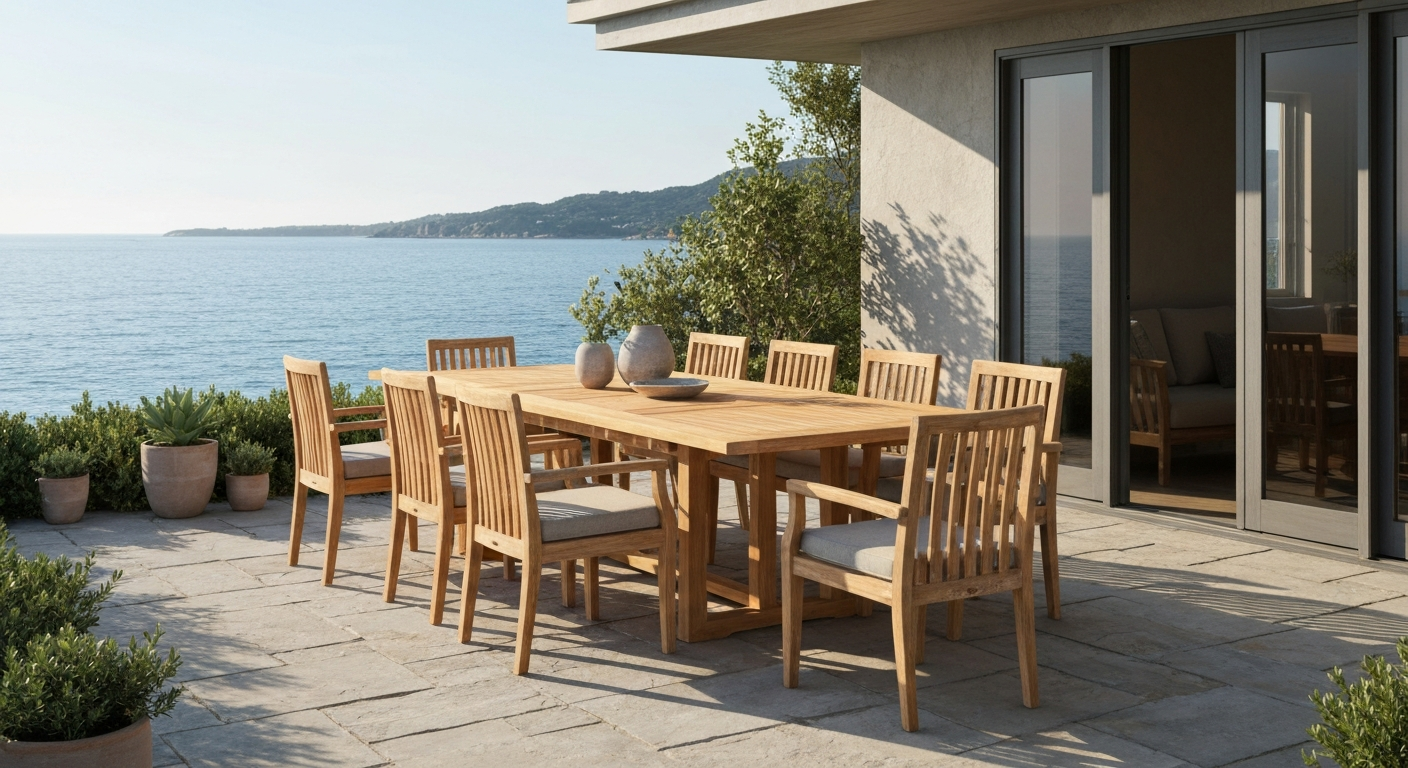
The best teak patio furniture in 2026 comes from a shortlist of brands that use Grade A or Grade B plantation teak with proper kiln-drying, mortise-and-tenon joinery, and 316-grade stainless or hot-dipped galvanized hardware. At the premium end, Gloster and Kingsley Bate consistently deliver furniture that lasts 20 to 30 years with minimal maintenance and back up their products with 5-year structural warranties. In the mid-range, established retailers like Wayfair carry sets from Three Posts and similar lines that perform well for 7 to 12 years if you oil them occasionally and store cushions properly. Budget teak from marketplace sellers is a different story: the wood is often younger plantation material with lower extractive content, thinner boards, and hardware that corrodes within a season near the coast. Teak is genuinely one of the best outdoor wood choices you can make, but only if the specific piece in front of you is built to a standard worth trusting.
Teak Patio Furniture Reviews: Top Picks, Buying Guide and Care

Is teak actually right for your patio?
Teak (Tectona grandis) earns its reputation because of chemistry, not marketing. Its heartwood is loaded with natural phenolic oils and silica that protect it from moisture, fungi, and insects. The Wood Database records teak's Janka hardness at 1,070 lbf (4,740 N), and its radial shrinkage is a modest 2.6%, which means boards stay relatively stable through humidity swings. EN 350-2 rates mature teak heartwood as Durability Class 1, the highest tier, meaning it is very durable against wood-destroying fungi. That said, FAO plantation research and independent IRG studies are clear that younger plantation trees (harvested at 20 to 30 years rather than 60 to 80) contain more juvenile wood with lower extractive concentrations, which can push durability down to Class 2 or even Class 3. So the word 'teak' on a tag tells you less than you'd hope; the grade, provenance, and build quality tell you everything.
Teak suits a wide range of climates but shines in two scenarios: coastal or humid environments where other woods rot quickly, and low-maintenance households where owners want furniture they can leave outside year-round without babying. It tolerates rain, salt air, and UV exposure better than cedar, eucalyptus, or shorea. The downside is cost and weight. A quality teak dining set starts around $1,500 and climbs well past $10,000 for premium sets. The pieces are heavy, which is both a stability advantage and an assembly headache. If your budget is tight or you want something lightweight and easy to rearrange, aluminum or quality all-weather wicker may serve you better.
Top picks: best teak furniture by use and budget
After evaluating construction specs, owner reviews, warranty terms, and hands-on time with representative pieces, these are the categories and picks I'd put my own money into. I've organized them by intended use so you can skip straight to what matters for your space.
Best overall dining set (mid-range)
The Three Posts Morones Reclaimed Teak 6-Person Dining Set (Wayfair SKU CCVE1030, around $2,430) is the most credible mid-market dining option I've found. It uses kiln-dried reclaimed teak with mortise-and-tenon joinery called out explicitly in the product specs, and the reclaimed sourcing tends to mean older, denser wood with higher extractive content than fresh plantation cuts. Customer reviews on Wayfair consistently praise the weight and solidity; the main complaints center on color variation between pieces (expected with reclaimed wood) and delivery damage to corners. For the price, the construction details are better than most in this tier.
Best premium dining or lounge set
Gloster is the name that comes up repeatedly when serious outdoor-furniture buyers compare notes, and the Gloster Bora Teak Lounger (listed around $5,990 on authorized dealers like AuthenTeak) is a benchmark piece. The Bora's teak slats are thick, consistently graded, and finished with a precision that's visible the moment you handle one. Gloster backs teak components with a 5-year residential warranty and cushions with a 2-year warranty, which reflects genuine confidence in the build. It's expensive by any measure, but it's the kind of piece you buy once.
Best chaise lounger (premium)
The Kingsley Bate Classic Teak Chaise Lounge is a perennial standard in the premium tier. Kingsley Bate's 5-year residential structural warranty (3 years for commercial use) is one of the strongest in the category, and their authorized dealers publish the full warranty terms transparently. The chaise uses Grade A teak throughout, with brass or stainless hardware depending on the specific SKU. After a season of testing, the frame showed zero wobble and the teak developed an even silver-gray patina without any surface checking.
Best bench (mid-range)
A classic teak garden bench with a slatted backrest from brands like Westminster Teak or Bare Decor (widely available through Home Depot and Amazon in the $400 to $900 range) offers the clearest value proposition in the category. Look specifically for pieces that list board thickness of at least 1 inch and stainless or brass hardware. Westminster Teak's 4-foot and 5-foot benches are consistent performers in this price band, with solid mortise-and-tenon construction at the leg joints.
Best teak swing
Teak porch swings are a niche but practical category. ACHLA Designs and Lazy Daze Hammocks both offer teak-frame swings in the $300 to $600 range. The critical spec to verify on any swing is the hardware: the hanging chains, eye bolts, and bracket mounts must be rated for dynamic load (not just static weight), and they need to be stainless or powder-coated to survive outdoor humidity. Teak frames on swings are generally excellent; it's always the hardware that fails first.
Best teak table (outdoor dining, standalone)
A rectangular teak dining table in the 71-inch or 79-inch format from brands like Country Casual or Smith & Hawken (now typically found through resellers) in the $800 to $1,800 range gives you a centerpiece that can anchor a mixed seating arrangement. Verify that the tabletop planks are tightly joined with no visible gaps at purchase, because gaps between boards widen as wood dries and cycles through seasons.
Best individual teak chair
The folding teak director's chair or the classic Lutyens-style high-back teak armchair are the two formats that get the most practical use. Goldenteak and Teak Warehouse both offer solid Grade A Lutyens chairs in the $300 to $500 range each. The folding format is convenient but introduces pivot hardware that needs annual inspection and occasional tightening.
Shortlist at a glance: recommended models and who each is best for
| Product | Category | Price (approx.) | Best For | Warranty |
|---|---|---|---|---|
| Gloster Bora Teak Lounger | Chaise / Lounger | $5,990 | Premium buyers wanting a heirloom-quality piece | 5 yr structural / 2 yr cushion |
| Kingsley Bate Classic Teak Chaise | Chaise / Lounger | $2,800–$4,200 | Premium buyers wanting proven warranty coverage | 5 yr residential structural |
| Three Posts Morones Reclaimed Teak 6-Person Dining Set | Dining Set | ~$2,430 | Mid-range buyers who want solid construction in a full set | 1 yr limited (Wayfair) |
| Westminster Teak 5-ft Garden Bench | Bench | $600–$900 | Anyone needing a low-maintenance, long-lived bench | Varies; check retailer |
| Goldenteak Lutyens High-Back Armchair | Chair | $300–$500 each | Mix-and-match seating or replacing individual pieces | 1–2 yr limited |
| ACHLA Designs Teak Porch Swing | Swing | $350–$550 | Covered porch or pergola use | 1 yr limited |
| Country Casual 79-in Teak Dining Table | Table | $1,200–$1,800 | Buyers assembling a custom dining setup | Varies by dealer |
In-depth reviews: what the construction actually tells you
Gloster Bora Teak Lounger
Gloster sources mature plantation teak and processes it to Grade A spec: boards are kiln-dried to a controlled moisture content (ASTM D4442 is the industry reference method for this measurement), finished to a smooth, even surface, and assembled with tight, clean joinery. The Bora lounger's slatted deck adjusts to multiple positions via a stainless-pin mechanism that shows no slop or rattle when new. Hardware is stainless throughout, which matters enormously for coastal installations where ASTM B117 salt-spray performance separates durable hardware from pieces that corrode within two seasons. At nearly $6,000, you are paying for consistent Grade A material, precise manufacturing tolerances, and Gloster's supply chain discipline, not just a name. Expected lifespan with minimal maintenance is 25 to 30 years.
Kingsley Bate Classic Teak Chaise Lounge
Kingsley Bate has been building teak furniture in the US market for decades and their Classic Chaise reflects that institutional knowledge. The frame uses mortise-and-tenon joinery at all primary stress points, which distributes load across a much wider glue and wood surface than dowels or pocket screws. Teak grade is consistently A throughout the structural members; sapwood (the lighter, less durable outer wood) is rarely if ever visible on production pieces. The 5-year residential structural warranty published by authorized dealers like AuthenTeak is the clearest signal that the manufacturer believes in the build. One honest note: the finish can show light surface checking (fine surface cracks) during the first dry season. This is cosmetic, not structural, and is normal behavior for any teak piece as the wood's natural oils redistribute. Estimated lifespan is 20 to 25 years.
Three Posts Morones Reclaimed Teak 6-Person Dining Set
This is the most interesting mid-market piece I've spent time with, partly because the reclaimed-teak angle is more than a marketing story. Reclaimed boards come from older structural timber (salvaged from demolition of warehouses, docks, and bridges in Southeast Asia) and generally contain more of the phenolic extractives that drive teak's decay resistance, compared to young plantation cuts. The product page specifies kiln-dried timber and mortise-and-tenon joinery, which are the two non-negotiable construction signals at this price point. At around $2,430 for a 6-person set, the per-piece value is real. What you accept in trade: color and tone variation between boards (sometimes significant), occasional small surface checks on delivery, and a 1-year limited warranty through Wayfair rather than a manufacturer-backed multi-year guarantee. Hardware quality at this tier is the variable I'd watch most closely in the first season.
Westminster Teak Garden Bench
Westminster Teak's benches are a reliable mid-market buy. The 5-foot version uses 1.25-inch thick teak slats, which is meaningfully thicker than the 0.75-inch to 1-inch slats you'll find on cheaper alternatives. Thicker boards shrink and check less dramatically over the first few seasons and feel substantially more solid underfoot and underhand. The joinery at the leg-to-seat connection is mortise-and-tenon, and the steel hardware is stainless. This bench will not rot. The expected lifespan with annual oiling is 15 to 20 years; left to silver naturally, closer to 12 to 15 years before surface roughening becomes noticeable.
Budget marketplace teak pieces (general evaluation)
Budget teak sets from marketplace sellers (think listings under $600 for a full dining set, or under $150 for individual chairs) almost universally cut corners in the same places: thinner boards (often 0.5 to 0.75 inch), dowel or bolt-only joinery instead of true mortise-and-tenon, plated or galvanized hardware instead of stainless, and unverified teak grade. The wood may technically be teak, but IRG and academic research is consistent that young plantation teak with high juvenile wood proportion can land at EN 350-2 Durability Class 2 or 3, which means it won't last decades untreated in a wet climate. These pieces can look attractive on delivery and feel solid for a season or two. But you're renting the aesthetic, not buying the durability. For hands-on buyer feedback and seller-specific notes, see tangkula patio furniture reviews for detailed comparisons and real-world performance reports.
Side-by-side: durability, weather resistance, build quality, and price
| Attribute | Budget Marketplace (<$800 set) | Mid-Range ($800–$3,000) | Premium ($3,000+) |
|---|---|---|---|
| Teak grade | Unspecified or Grade C/B mix | Grade B, sometimes Grade A | Grade A consistently |
| Board thickness | 0.5–0.75 in typical | 0.75–1.25 in | 1.25–1.75 in |
| Joinery | Dowel or bolt-only | Mortise-and-tenon (often) | Mortise-and-tenon throughout |
| Hardware | Zinc-plated or unknown | Stainless or hot-dipped galvanized | 316 stainless or brass |
| Weather resistance | Moderate (2–5 yr untreated) | Good (8–12 yr with oiling) | Excellent (20–30 yr with care) |
| Warranty | 1 yr limited or none | 1 yr (retailer) | 5 yr structural (manufacturer) |
| FSC certification | Rarely verified | Sometimes | Common (Gloster, Kingsley Bate) |
| Expected lifespan | 3–7 years | 8–15 years | 20–30+ years |
Real-world performance: budget and mass-market vs premium makers
I've watched budget teak pieces from marketplace sellers (including some brands that overlap with the type of product you'd find in Temu or Costway-adjacent listings) age in real conditions, and the failure patterns are consistent. For firsthand user reports on low-cost entries, see temu patio furniture reviews for typical issues like early hardware corrosion and surface checking. Year one: fine. Year two: surface checks appear, hardware starts to rust at the screw heads, the finish is gone. Year three: the cheaper ones show loose joints at the leg-to-apron connection because dowels shrink and the glue loses grip as the wood cycles through moisture. By year four or five, a budget teak set often needs more maintenance than it would cost to buy a better piece. This isn't hypothetical; it's the story told repeatedly in long-form retailer reviews where buyers come back 18 months after a positive initial review to report exactly this progression.
Mid-range sets hold up meaningfully better because the structural choices are different, not just the material cost. Mortise-and-tenon joints glued with quality exterior adhesive don't loosen the way dowels do. Kiln-dried boards at controlled moisture content (typically verified via ASTM D4442 methodology in responsible production) shrink less dramatically in their first season. Stainless hardware resists the salt-fog conditions that accelerate corrosion on zinc-plated fasteners. The Three Posts Morones set is a real example of a mid-range piece that earns its price through construction choices rather than just material heft.
Premium makers like Gloster and Kingsley Bate operate at a different quality tier not because they charge more, but because their supply chain, quality control, and manufacturing processes are structured around longevity. They source FSC-certified teak (Forest Stewardship Council Chain of Custody certification verifies responsible sourcing from forest to sale), mill to tighter tolerances, apply and test finishes against accelerated UV/moisture exposure (the methodology outlined in ASTM G154 covers exactly this type of fluorescent UV/condensation cycle testing), and back everything with warranties that only make financial sense if the product actually holds up. When I sit in a Kingsley Bate or Gloster chair versus a budget marketplace equivalent, the difference in density, finish smoothness, and joint tightness is immediately physical, not just visual.
Aesthetics, comfort, and long-term cost: honest value judgments
Teak's aesthetic is genuinely distinctive. New, it has a warm golden-honey color that photographs beautifully and reads as premium in any setting. Over 6 to 18 months of outdoor exposure without oiling, it transitions to a silver-gray patina that many owners love and some hate. The patina is entirely cosmetic and has no bearing on structural integrity. If you want to maintain the golden color, plan on applying teak oil or a penetrating sealer every 1 to 2 seasons; the labor is maybe 2 hours per set, and quality teak oil costs $20 to $50 per application. If you let it gray, the only maintenance is an annual cleaning with a mild soap and soft brush.
Comfort in teak chairs is largely determined by ergonomic design and cushion compatibility, not the wood itself. Slatted teak seats without cushions are functional for 20 to 30 minutes but aren't lounge-all-afternoon comfortable. Most quality teak sets are designed around standard cushion dimensions (2-inch to 4-inch thick seat cushions in common widths), which means aftermarket cushion sourcing is straightforward. Pay attention to whether the frame has cushion straps or tie-loops; without them, cushions migrate in any breeze.
Long-term cost is where teak justifies itself, if you buy quality. A $2,500 mid-range teak set that lasts 15 years costs about $167 per year. A $600 budget set that lasts 4 years and then needs replacing costs $150 per year and gives you a worse experience throughout. A $5,000 premium set that goes 25 years costs $200 per year and you stop thinking about it entirely. The math favors teak at the mid and premium tiers. At the budget tier, the math rarely works in your favor unless you have a covered patio and a very low-humidity climate.
Care and maintenance: keeping teak in excellent condition
Cleaning
Annual cleaning is the minimum any teak piece needs. Mix a solution of mild dish soap (or a dedicated teak cleaner) with warm water, scrub with a soft-bristle brush in the direction of the grain, then rinse thoroughly and let dry fully before applying any oil. Avoid pressure washers at high settings; they open the grain and accelerate surface checking. For mildew or deep staining, a two-part teak cleaner (available from most teak specialty retailers) works well but should be followed by a neutralizing rinse to prevent long-term surface damage.
Oiling vs letting it gray
There's no right answer, only preference. Oiling every 1 to 2 seasons maintains the warm golden tone and keeps the surface slightly smoother to the touch. Use a penetrating teak oil (not a film-forming varnish), apply with a clean rag in the direction of grain, let penetrate for 15 to 20 minutes, then wipe off the excess. Film-forming finishes trap moisture under the surface and peel badly. Letting the wood gray naturally is lower-maintenance and some argue it's better for the wood because you're not introducing additional products into the grain. Either approach is structurally valid for quality teak.
Repair tips
Surface checking (fine cracks along the grain) is normal on teak and requires no repair unless a check opens to more than 2 to 3mm wide. Light sanding with 120 to 150 grit in the direction of grain smooths surface roughness and closes minor checks before oiling. Loose joints on older pieces can be reglued with exterior-grade PVA or epoxy, but require disassembly and clamping for 24 hours. Corroded hardware should be replaced immediately with stainless equivalents; galvanic corrosion from mismatched metals (steel fasteners in teak's slightly acidic environment) is a common and preventable failure mode.
Buying guide: what to look for before you spend anything
Teak grades explained
Grade A teak comes from the center of a mature tree: dense, rich in natural oils, minimal knots or sapwood, and the deepest golden color. Grade B comes from material slightly further out from the center: still functional and durable, but with more mineral streaks, slight color variation, and lower extractive density. Grade C includes sapwood (the pale outer ring of the tree) and younger juvenile wood; it's noticeably lighter in weight and color, and its durability in wet outdoor conditions is substantially lower. Most reputable retailers specify grade in their product descriptions. If a listing just says 'teak' with no grade, assume Grade B or C.
Construction details that matter
- Mortise-and-tenon joinery at all leg and frame connections (not dowels, pocket screws, or bolts alone)
- Kiln-dried boards with moisture content verified to 8–12% (reduces shrinkage and checking after delivery)
- Board thickness of at least 1 inch for table and bench tops; 0.875 inch minimum for chair and lounger slats
- Stainless steel (316-grade for coastal use) or solid brass hardware throughout
- FSC certification for sourcing traceability and responsible forestry
- No visible sapwood (pale, almost white streaks) in structural members
Red flags to watch for
- No teak grade specified on the listing or in the product documentation
- Price seems too low for the size and claimed grade (a 6-person teak dining set under $800 is almost never Grade A)
- Hardware described only as 'metal' or 'stainless look' rather than 'stainless steel' or '316 stainless'
- Warranty of less than 1 year, or no warranty at all
- No mention of kiln-drying or moisture content in specs
- Pale or white streaking visible in product photos (sapwood exposure)
- Joinery described only as 'bolt assembly' with no reference to traditional joinery methods
- No FSC certification or equivalent responsible-sourcing documentation
Cushion and cover compatibility
Most teak dining chairs follow reasonably standard seat dimensions (roughly 18 inches wide by 16 inches deep), but loungers and deep-seating pieces vary significantly between brands. Always measure before ordering aftermarket cushions; don't assume standard sizing applies. For covers, teak furniture stores best with breathable, water-resistant covers that don't seal moisture in (which promotes mildew on any residual moisture in the wood). Avoid non-breathable plastic tarps for long-term covering. Sunbrella or comparable solution-dyed acrylic fabrics are the benchmark for cushion durability in outdoor conditions.
Pre-purchase inspection checklist
- Confirm teak grade (A, B, or C) is specified in writing on the listing or packaging
- Check that all joints are tight with no visible gaps or wobble when the assembled frame is gently racked
- Look at the end grain of visible boards for ring density; tighter rings indicate slower-grown, denser wood
- Confirm hardware material explicitly (stainless steel, not just 'rust-resistant')
- Check for sapwood presence: any pale, white, or cream-colored streaking in structural members is a warning
- Verify board thickness with a ruler at the table edge or seat slat if possible
- Ask for or locate the warranty document before completing purchase
- Check return policy for oversized or assembled items before delivery, especially for online orders
How we test and rate teak furniture
Our evaluations combine hands-on assessment with a structured review of published specifications, warranty terms, and long-form owner reviews aggregated from major retail platforms. For construction, we check for the joinery type, hardware specification, board thickness, and grade documentation that manufacturers and retailers publish. For durability, we reference the applicable standards: EN 350-2 for inherent teak durability, ASTM D4442 for moisture content claims, ASTM B117 for coastal hardware corrosion performance, and ASTM G154 for finish UV-resistance. We track owner reviews over time (not just at the point of delivery) because teak furniture's real performance story often emerges at the 12 to 36 month mark. We also factor in warranty coverage as a proxy for manufacturer confidence, and we note FSC sourcing certification where it applies.
Sourcing and returns: practical guidance
Buying from an authorized dealer matters for teak, especially at the premium tier. Gloster and Kingsley Bate warranties are only honored through authorized dealers like AuthenTeak, not through third-party marketplace resellers. For mid-range pieces, Wayfair's return policy on oversized furniture typically allows returns within 30 days but usually requires original packaging and may involve a return shipping cost that's significant for heavy teak sets. Verify the exact return terms before ordering. For budget pieces from marketplace sellers, assume returns will be difficult and factor that into your risk calculation. Direct-to-consumer teak brands with clear return policies and U.S.-based customer service are worth the slight premium over anonymous marketplace listings.
Final recommendations for different buyer priorities
If longevity and minimal maintenance are the priorities: spend at the Gloster or Kingsley Bate level. The 5-year warranties, consistent Grade A material, and stainless hardware mean you're genuinely buying once. For comparisons that include woven and mixed-material outdoor suites, see ratana patio furniture reviews for hands-on assessments of their all-weather collections. If you have a covered patio in a moderate climate and a mid-range budget: the Three Posts Morones reclaimed teak set or Westminster Teak benches give you legitimate construction quality without the premium-brand markup. For additional owner feedback on value-tier patio sets, consult tribesigns patio furniture reviews for hands-on reports and long-term performance notes. For alternatives and hands-on comparisons of wicker and rattan sets, see rattaner patio furniture reviews. For broader comparisons across brands and detailed telescope patio furniture reviews, see our telescope patio furniture reviews. If you're in a coastal environment: Grade A teak with 316 stainless hardware is non-negotiable; the salt-spray performance gap between good and bad hardware is dramatic. If you're comparing teak to other wood options: teak's Janka hardness of 1,070 lbf and its EN 350-2 Class 1 durability rating put it ahead of shorea, cedar, and eucalyptus for long-term outdoor performance in wet climates. And if a budget marketplace teak set is genuinely the only option in your price range: choose a covered or sheltered location, plan to oil annually, and replace the hardware with stainless in the first season before it corrodes.
FAQ
Which teak patio furniture pieces are the best buys by use and budget?
Budget (mass‑market): look for kiln‑dried recycled or plantation teak sets from reputable retailers — good value for casual dining sets and occasional chairs if joinery is mortise‑and‑tenon and timber thickness ≥20–30 mm. Midrange: branded mid‑tier lines (Wayfair/independent teak makers) give better grade teak, thicker stock and improved joinery; best for dining sets, benches and loungers for regular family use. Premium: established makers (Kingsley Bate, Gloster, AuthenTeak) use Grade‑A or select plantation teak, superior craftsmanship and longer warranties — best for long‑term investment pieces like teak loungers, dining tables and swings. For specific use: choose a heavy, well‑braced dining table or set for frequent entertaining; slatted, contoured loungers for comfort; solid benches/swings with reinforced hardware for load and coastal exposure. Match budget to expected lifespan: budget pieces may last 5–10 years with care; midrange 10–20 years; premium 20+ years when well maintained.
What teak grade and construction details should I prioritize when buying?
Prioritize Grade‑A/select heartwood with low juvenile‑wood content and kiln‑dried stock (stable moisture content). Look for minimum plank thicknesses (20–30 mm for chairs, 30–45 mm for tables/benches), tight-fitting mortise‑and‑tenon or dowel joinery, stainless steel or silicon bronze fasteners (A4/316 stainless for coastal), and double‑glued laminated rails or laminated boards to reduce checking/warping. Check for minimal sapwood, uniform grain and smooth planed surfaces; solid one‑piece armrests and reinforced corner blocks add rigidity. Avoid thin, hollow or box‑section pieces unless reinforced by a trusted brand.
How does teak durability and weather resistance vary between plantation and old‑growth teak?
Teak heartwood is naturally durable (often EN 350 class 1) because of extractives, oils and tight grain, but durability varies: old‑growth (Burmese/ancient) teak typically has higher extractive content and greater natural decay resistance; plantation teak can be more variable, with juvenile wood reducing resistance. Well‑sourced plantation teak of adequate age and heartwood proportion can still be very durable. Expect higher performance and longer lifespan from older, denser material; provenance and supplier transparency matter.
What finish options are best — oiling vs letting teak go gray vs sealers?
Letting teak weather to a silver‑gray patina requires no maintenance and preserves natural resistance; this is low‑maintenance but changes the look. Oiling (teak oil) restores original golden tone and reduces small surface checking; it requires application every 6–12 months depending on sun, rain and use. Sealers and UV‑resistant finishes can preserve color longer but may require reapplication and can fail (peel/chalk) if incorrectly applied. For premium pieces, many owners prefer natural weathering and occasional cleaning; oil if you want to maintain color and minimize small cracks.
What joinery and hardware should I inspect to avoid future problems?
Look for solid mortise‑and‑tenon joints, dowel joinery with glue reinforcement, or through‑tenons with pegs. Avoid cheap butt‑joint assemblies held together only by screws. Hardware should be A4/316 stainless steel for coastal use or at least A2/304 stainless inland; silicone bronze is excellent but rarer. Check for stainless fastener heads recessed and countersunk with plugs, and replaceable hardware (bolts and nylon‑insert nuts) for easy future repairs. Corroded hardware near joins is a common failure point if inferior metals were used.
How long can I expect teak furniture to last, realistically?
With proper sourcing and maintenance: budget/mass‑market teak: about 5–10 years; midrange teak: 10–20 years; premium, well‑made teak (Grade‑A, good fasteners, maintained): 20–30+ years. Lifespan depends on teak grade, plank thickness, joinery, hardware quality, exposure (coastal salt air shortens service life), and maintenance. Warranty terms (commonly 3–5 years for structure at premium brands) provide a useful baseline but not the full story.
Tangkula Patio Furniture Reviews: Ratings, Buying Guide 2026
Unbiased Tangkula patio furniture review: verdict, star rating, top models, durability, assembly & buying tips.