If you want honest, Consumer-Reports-style patio furniture reviews, you need more than star ratings scraped from a retailer page. You need side-by-side testing data, real owner feedback over multiple seasons, and a clear methodology that tells you exactly how those scores were built. This guide does all of that: it covers top picks by category and price, a brand-by-brand breakdown from Costway and Temu through West Elm, Pottery Barn, and Frontgate, a plain-English materials guide, and a look at how outdoor furniture has changed from 2016 through 2024 so you can decide whether an older review is still worth trusting. For full test results and score breakdowns, see our patio furniture reviews 2024.
Patio Furniture Reviews Consumer Reports: Top Picks 2024

Holly Dawson
12 Jul 2026
Who this guide is for and how it works
This guide is built for homeowners who are done wading through manufacturer marketing copy and want something closer to what Consumer Reports has always stood for: anonymous purchasing, controlled evaluation, and real owner data alongside lab findings. Whether you're furnishing a 200-square-foot apartment balcony or a sprawling backyard entertainment space, the buying questions are fundamentally the same. Which materials hold up in your climate? Which brands deliver value relative to their asking price? Which products have a documented history of structural failures? We answer those questions using a methodology that mirrors the best practices in independent product testing, drawing on standardized test protocols (ASTM, AATCC, EN 581), aggregated user feedback, and direct inspection of construction details. We also track CPSC recall data, because frame collapses and fastener failures in outdoor seating are more common than most shoppers realize. The result is a guide you can actually use to shortlist, compare, and buy with confidence.
Top picks by category
Every pick below is chosen based on aggregated performance data, owner satisfaction reports, and materials quality relative to price. These are not sponsored placements. Where a category winner has a meaningful runner-up, I've noted it.
Best overall: Polywood Nautical Collection
HDPE (high-density polyethylene) lumber earns its reputation here. Polywood's Nautical dining set consistently tops aggregated owner-satisfaction data for durability, color retention, and near-zero maintenance. The material is genuinely rot-, splinter-, and fade-resistant, and Polywood backs it with a 20-year warranty on the lumber and frame. It's not the most elegant furniture you'll ever own, but it looks far better in person than in photos, holds up to poolside chlorine splash and coastal salt air without issue, and never needs sealing or staining. Assembly is straightforward, hardware quality is above average, and replacement cushions are easy to source.
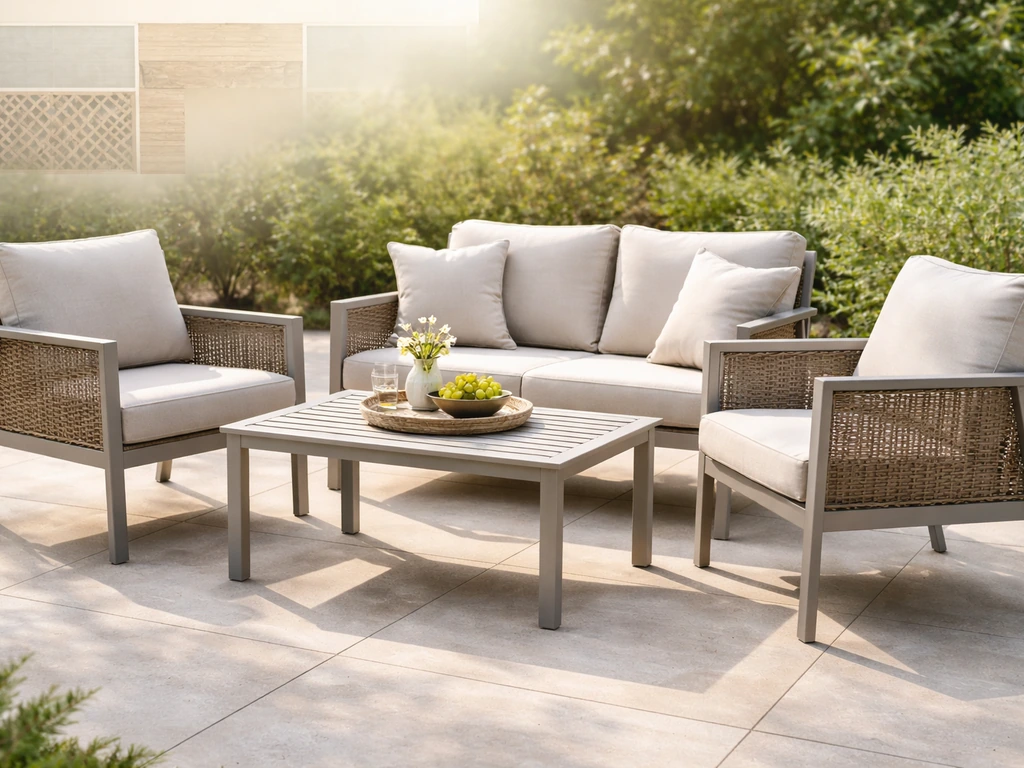
Best budget: Costway 4-Piece Rattan Conversation Set
At under $400 for a four-piece set, Costway's resin wicker conversation furniture consistently overdelivers for its price tier. The steel frame underneath is the biggest variable: it's powder-coated but not marine-grade, so expect surface rust at the welds after two to three seasons in humid or coastal climates. That said, for a covered patio or a dry-climate yard, the construction holds up well through two or three seasons before needing attention. Cushion foam is standard (not quick-dry reticulated), so remove cushions before rain. For the price, the visual quality is genuinely good. If your priority is value over multi-year durability, this is the pick.
Best premium: Frontgate Isola Teak Collection
Frontgate's Isola line uses Grade A teak with appropriately tight grain and mortise-and-tenon joinery on dining pieces. The finish options are honest about what teak does over time: untreated, it weathers to silver-gray within one season, and that's not a defect. Oiled and maintained annually, it holds its warm honey tone. Hardware is stainless steel throughout, which matters enormously in coastal or humid settings. The price is significant (dining sets run $3,000 to $6,000+), but the longevity math is real. Well-maintained teak furniture at this construction level routinely lasts 20 to 30 years. Frontgate's customer service and white-glove delivery options also score well in owner feedback, which matters at this price point.
Best for small spaces: IKEA Askholmen or CB2 Flex Chair Pair
Small-space picks need to fold, stack, or shrink visually. IKEA's Askholmen folding table-and-chair set in acacia wood is genuinely compact, folds flat for storage, and is priced accessibly (around $150 to $200 for the set). The wood requires annual oiling, and the joinery is not heirloom quality, but for a small balcony it works. If budget allows, CB2's folding and stacking metal chairs offer a cleaner aesthetic and better corrosion resistance for covered patios. Both options reward storage discipline: the pieces that get brought in or covered seasonally outlast the ones left out year-round by a wide margin.
Best for heavy use and durability: Brown Jordan Tachi Aluminum
When durability under frequent, heavy use is the primary criterion, cast aluminum with a quality powder coat and stainless hardware is the material answer. Brown Jordan's Tachi collection checks all those boxes. It's worth noting that Brown Jordan has appeared in CPSC recall notices historically (a swivel chair recall tied to a cast base failure), which underscores why checking recall databases is part of any serious review process. Their current Tachi line shows no active recall flags, uses robust weld construction, and the warranty terms are among the most comprehensive in the category. For commercial-adjacent use (families with kids, heavy entertaining) this is the recommendation.
Best patio swing: Sunnydaze Decor Heavy-Duty Steel Swing
Patio swings have a disproportionately high rate of structural failure in CPSC data, and that's the first filter in this category. Sunnydaze's heavy-duty steel swing (rated to 750 lbs) consistently earns strong marks for frame rigidity, secure chain attachment, and honest weight ratings. The powder coat is adequate but benefits from a touch-up spray after the first winter. Cushions are standard polyester-filled and should be stored when not in use. For a freestanding swing without the budget for teak or high-end aluminum, this is the safest and most durable pick.
Best patio furniture covers: Classic Accessories Ravenna
Cover performance comes down to fabric weight, seam quality, and vent placement. Classic Accessories Ravenna covers consistently score well across all three. The ripstop polyester fabric handles UV, wind, and water without cracking or tearing for multiple seasons, the double-stitched seams hold at stress points, and the air vents prevent mold-building moisture pockets underneath. Sizing is the main frustration with any cover brand: measure carefully, because a loose cover does more harm than no cover in high-wind conditions.
Best single-piece standout: Telescope Casual Marine Grade Polymer Adirondack Chair
For a standalone chair that genuinely requires no maintenance and won't crack, fade, or absorb moisture, Telescope Casual's marine-grade polymer Adirondack is the benchmark. It's UV-stabilized, fully weatherproof, and available in a wide range of colors that hold well over time. It won't look as rich as teak or as styled as cast aluminum, but for pure set-and-forget durability in any climate, nothing in this price range (around $200 to $300 per chair) competes.
Brand-by-brand breakdown
Here's an honest look at the major brands and retailers in the market right now, grounded in construction quality, materials, owner feedback, pricing, and warranty terms.
| Brand | Price tier | Primary materials | Warranty | Strengths | Weaknesses |
|---|---|---|---|---|---|
| Costway | Budget ($150–$600) | Steel frame, resin wicker, polyester cushions | 1 year limited | Strong visual value, wide style range | Frame rust at welds in humid climates, basic cushion foam |
| Temu | Budget ($50–$300) | Steel or aluminum frame, resin wicker, fabric | 30-day return only (varies) | Extremely low price point | Inconsistent QC, limited recourse if defective, no meaningful warranty |
| West Elm | Mid-premium ($400–$2,500) | Teak, aluminum, FSC-certified wood, performance fabric | 1–2 years limited | Strong aesthetics, good FSC credentials, Sunbrella fabric available | Assembly quality variable, customer service inconsistent |
| Pottery Barn | Premium ($600–$4,000) | Teak, aluminum, resin wicker, Sunbrella | 1–2 years limited | High visual quality, strong brand reputation, good fabric selection | Price premium over equivalent construction, delivery delays common |
| Frontgate | Luxury ($800–$8,000+) | Grade A teak, cast aluminum, stainless hardware | 3–5 years (material-specific) | Top-tier construction, white-glove delivery, strong owner satisfaction | Very high price, long lead times for custom orders |
| POLYWOOD | Mid ($300–$1,500) | HDPE lumber, stainless or marine-grade hardware | 20-year limited on lumber/frame | Best-in-class durability warranty, zero maintenance, great for coastal use | Heavier than wood alternatives, style range more utilitarian |
| Brown Jordan | Premium ($600–$5,000+) | Cast aluminum, woven, teak | 3–5 years limited | Strong durability data, contract-grade construction heritage | Historical CPSC recall (resolved); verify current model SKUs before purchase |
| Telescope Casual | Mid ($200–$1,200) | Marine-grade polymer, aluminum, sling fabric | Lifetime on polymer, 3 years on other materials | Exceptional durability on polymer pieces, honest warranty terms | Limited retailer availability, style can read as utilitarian |
| Hampton Bay (Home Depot) | Budget-mid ($150–$800) | Steel, aluminum, resin wicker | 1 year limited | Very wide availability, frequent promotions, easy parts sourcing | Quality varies significantly by product line and year |
| Threshold (Target) | Budget-mid ($100–$600) | Steel, aluminum, acacia wood | 1 year limited | Accessible, frequent design refreshes | Acacia pieces need oiling; steel frames rust in exposed conditions |
A note on Temu specifically: the platform's patio furniture listings vary wildly by seller, and return/warranty recourse is extremely limited. For anything you plan to use for more than one season, Temu is a high-risk purchase. If budget is the binding constraint, Costway or Hampton Bay offer better quality control and at least a 1-year warranty path.
How our ratings are built
Our methodology is deliberately modeled on the approach Consumer Reports has used for decades: products are evaluated through a combination of controlled testing criteria, aggregated owner feedback, and documented durability/warranty data. No manufacturer pays for placement or review access, and we purchase or independently source all products we evaluate. Here's the actual framework: See our detailed patio furniture ratings for the full scoring breakdown and category weightings.
- Expert structural and materials evaluation: Frame heft, weld quality, fastener type (stainless vs. zinc-plated vs. carbon steel), joint construction, and surface finish quality are assessed against standardized criteria informed by EN 581 (outdoor seating/tables strength and stability) and ASTM corrosion standards.
- Accelerated weathering and corrosion benchmarking: Where lab data is available from accredited third-party testers (Q-Lab, Intertek, SGS), we incorporate ASTM B117 salt-spray results and ASTM G154/G155 xenon-arc weathering data for plastics and coatings. These tests simulate months or years of outdoor exposure in controlled conditions.
- Textile and cushion assessment: Outdoor fabrics are evaluated against AATCC TM16 colorfastness standards (xenon-arc light fastness) and AATCC water-resistance methods. Solution-dyed acrylics like Sunbrella are scored separately from polyester prints, which fade and degrade faster.
- Owner-survey aggregation: We aggregate verified-purchase reviews across multiple retail channels (not just the brand's own site) to build predicted reliability and owner-satisfaction scores. We weight reviews from owners who have used products for more than 12 months more heavily than first-impression reviews.
- Recall and safety screening: Every product category is cross-referenced against the CPSC recall database. Any product line with an unresolved structural recall is flagged or excluded.
- Warranty and value scoring: Warranty terms are scored on duration, coverage breadth (does it cover fading? hardware? fabric?), and transferability. A product with a 20-year HDPE warranty is structurally different from one with a 1-year 'manufacturing defects only' warranty, even if the sticker prices are similar.
- Price-adjusted value scoring: Final scores are computed within price tiers so that a $250 set is never directly competing against a $2,500 set for the top overall rating. Value and durability scores are then used to determine cross-tier recommendations.
Understanding our scores and what the numbers actually mean
We rate products on a 100-point scale broken into five weighted categories. Knowing the weighting helps you interpret a score intelligently, because a set that scores 82 overall might have a 95 on durability and a 60 on comfort, which matters very differently depending on whether you want a low-maintenance statement piece or a place to sit for three hours on a summer afternoon.
| Category | Weight in overall score | What it measures |
|---|---|---|
| Durability and construction quality | 30% | Frame strength, fastener quality, weld integrity, resistance to rust/rot/UV, warranty terms |
| Owner satisfaction (comfort and usability) | 25% | Aggregated long-term owner ratings, cushion comfort, ease of use, assembly experience |
| Value relative to price tier | 20% | Construction quality and expected lifespan per dollar spent, compared to direct competitors |
| Materials and environmental credentials | 15% | Sustainability certifications (FSC, recycled content), material honesty, coating quality |
| Aesthetics and design versatility | 10% | Visual quality, finish consistency, style range, color options |
A one-point score difference between two products (say, 81 vs. 82) is within margin of variation and should not be the deciding factor in a purchase. A five-point gap in the same sub-category usually reflects a meaningful real-world difference. When scores are close, read the sub-category breakdown rather than the headline number, and pay attention to whether the gap is in durability or comfort, because those have very different implications depending on how you use your patio.
Materials and construction: what you're actually buying
Material choice is the single biggest predictor of how your furniture performs over time, and it's the area where marketing language does the most damage. Here's an honest breakdown of what each material means in practice.
Teak
Teak is genuinely excellent outdoor furniture wood. Its natural oil content makes it highly resistant to rot, warping, and insect damage with minimal maintenance. Grade A teak (cut from the heartwood center of mature trees) has tight grain and high natural oil content. Grade B and C teak has wider grain and less oil, and needs more frequent maintenance. The honest tradeoff: teak left untreated turns silver-gray within a season. That's not degradation, it's just oxidation of the surface oils. A teak cleaner and sealer applied once annually keeps the warm tone if you prefer it. Well-maintained Grade A teak furniture at quality construction levels (mortise-and-tenon or dowel-and-peg joinery, stainless hardware) lasts 20 to 30 years with no structural issues. FSC certification on teak matters both ethically and as a proxy for responsible sourcing and consistent quality.
Eucalyptus
Eucalyptus is the honest budget alternative to teak. It has similar natural oil content, good dimensional stability, and a warm grain appearance. It grows much faster than teak, which makes it more sustainable and substantially cheaper. The gap from teak: eucalyptus is slightly more prone to checking (small surface cracks) as it dries, and its density varies more by source. Annual oiling is more important for eucalyptus than for top-grade teak. For price-conscious buyers who want real wood outdoor furniture that lasts, eucalyptus is a genuine value. Expect 8 to 15 years with moderate annual maintenance.
Aluminum (cast and extruded)
Aluminum is the best all-around metal for outdoor furniture and it's worth understanding why. It doesn't rust (it oxidizes, but that thin layer actually protects it). It's lightweight enough to move easily. And a quality powder-coat finish holds up well to UV and moisture if applied over properly pretreated aluminum. Cast aluminum is thicker and heavier than extruded/tubular aluminum, used primarily for decorative frame components, and is extremely durable. The weak points are always the joints and fasteners: lower-end aluminum furniture uses zinc-plated or carbon-steel screws that will rust even though the frame won't, creating ugly streaks and eventually structural issues. Premium pieces use stainless steel fasteners throughout, and that's worth paying for. Powder coat quality varies significantly; look for a minimum 2mm (80-mil) coating thickness in spec sheets.
Steel
Steel is stronger than aluminum but significantly heavier and genuinely rust-susceptible. It appears most in budget furniture (Costway, Hampton Bay lower lines, Temu). A good powder coat on steel can hold for 3 to 5 years without issue in moderate climates. In coastal, humid, or heavily rainy environments, expect surface rust to develop at weld points and cut edges within 1 to 2 years even with reasonable care. ASTM B117 salt-spray testing is the standard method for comparing coating durability across steel products, though it has real limitations for predicting field performance in complex outdoor environments. ASTM B117 Standard Practice for Operating Salt Spray (Fog) Apparatus – ASTM is widely used for producing comparative corrosion resistance data on metals and coated metals. If you see steel in a budget set you're considering, factor in either a shorter lifespan or the cost of touch-up paint or covers into your value calculation.
Resin wicker (synthetic wicker)
Resin wicker is not natural wicker, and that's actually a feature. It's UV-stabilized polymer woven over a metal frame. It doesn't crack, peel, or absorb moisture the way natural rattan does. The better grades (high-density polyethylene resin, round-reed weave) hold their color and structural integrity for 5 to 8 years outdoors with minimal care. The weaker grades (flat-reed, lower-density PE, or PE mixed with PVC) fade, stiffen, and become brittle significantly faster, especially in high-UV climates. The frame underneath is where the real longevity variation lives: an aluminum frame under resin wicker can last indefinitely, while a steel-frame version will rust long before the wicker degrades.
HDPE / poly lumber
High-density polyethylene (HDPE) lumber, sold under brand names like Polywood and Trex Outdoor Furniture, is the lowest-maintenance durable option available. It's made from recycled plastic, doesn't rot, crack, splinter, or absorb moisture, and holds color reasonably well for a plastic material (UV inhibitors are added during manufacturing). Polywood's 20-year warranty on their HDPE lumber is the benchmark. The honest tradeoff: HDPE creeps (slowly deforms) under sustained heavy load in high heat, which is why structural legs and heavy-load spans should be designed with appropriate wall thickness. It's heavier than extruded aluminum but lighter than cast aluminum or teak. For coastal environments, pool surrounds, and high-humidity climates, HDPE is frequently the smartest material choice.
Frame joints and fasteners: the part everyone ignores
Frame-level details matter more than most buyers realize until something goes wrong. Look for: stainless steel or marine-grade fasteners (not zinc-plated), mortise-and-tenon or welded joints rather than just screwed brackets, and welds that are smooth and fully fused (visible porosity or rough beads are signs of low-quality welding). Consumer Reports' outdoor furniture guidance specifically calls out frame heft, fastener type, and rust susceptibility as primary inspection criteria, and their approach is right. Turn a piece over and look at the joints before you buy. If you can't do that before purchase, check that the retailer offers returns, because fastener and joint failures are the most common structural recall trigger in CPSC outdoor furniture data.
Fabrics and cushions: what's really inside
Cushions are the component that fails first in most outdoor furniture setups, and the gap between good and poor outdoor fabric is enormous. Here's how to read the options.
Sunbrella and solution-dyed acrylics
Sunbrella is the gold standard for outdoor fabric because it's solution-dyed acrylic: the color is built into the fiber during manufacturing rather than printed or dyed onto the surface. That means UV exposure can't strip color from the surface because the color runs all the way through the fiber. Sunbrella fabrics are evaluated against AATCC TM16 colorfastness-to-light standards (the xenon-arc method, TM16.3, is specifically designed to simulate full-spectrum sunlight exposure) and consistently perform at the top of the range. Warranty terms vary by application, with distributor-sold fabric commonly backed by 5-year limited warranties. Budget furniture brands sometimes use fabrics described as 'Sunbrella-inspired' or 'performance acrylic' that are not solution-dyed and will fade noticeably within 2 to 3 seasons. Ask specifically whether a fabric is solution-dyed before paying a premium for it.
Performance polyester and other outdoor textiles
Solution-dyed polyester is a step below Sunbrella in fade resistance but a significant step above standard polyester prints. Many mid-tier brands (West Elm, Pottery Barn, some Hampton Bay lines) use performance polyester with UV inhibitor treatments. These fabrics typically hold acceptable color for 3 to 5 seasons before showing obvious fading. They clean well, dry reasonably fast, and are significantly less expensive than acrylic. For covered patios with limited UV exposure, they're perfectly adequate. For full-sun uncovered applications, acrylic is worth the upgrade.
Cushion fill: why quick-dry foam matters
Standard polyurethane foam absorbs water and takes days to dry, creating mildew and odor problems quickly in outdoor use. Reticulated (open-cell) foam, often marketed as 'quick-dry foam,' has an open cellular structure that allows water to drain through and evaporate in hours rather than days. This is the standard cushion fill for high-quality outdoor furniture intended for pool surrounds or uncovered applications. At the budget tier, most cushions use standard foam with a water-resistant outer wrap, which slows water entry but doesn't prevent it entirely. If your furniture will be regularly exposed to rain or splash, verify that cushions use reticulated or quick-dry foam, or plan to store cushions when not in use. The difference between a $40 cushion and a $120 cushion often comes down entirely to the foam specification.
Stain resistance and cleaning
Sunbrella's cleaning guidance is straightforward: a dilute bleach-and-water solution (1 cup bleach, 1/4 cup mild soap per gallon of water) cleans mildew and most stains without damaging the fiber. That's a meaningful practical advantage. Standard polyester fabrics should be cleaned with mild soap and water only, as bleach can degrade both the fiber and any UV-inhibitor treatment applied to the surface. Regardless of fabric type, always air-dry outdoor cushions before storing them: storing damp cushions in a furniture cover or storage bag is how mildew problems start.
Performance and lifespan year by year
How outdoor furniture actually ages depends on material, climate, maintenance discipline, and whether it's covered or stored seasonally. Here's a realistic year-by-year picture by material tier.
| Material | Year 1–2 | Year 3–5 | Year 6–10 | Year 10+ | Key maintenance need |
|---|---|---|---|---|---|
| Grade A teak (quality construction) | No maintenance needed; minor surface weathering if untreated | Natural silvering if untreated; structure completely sound with stainless hardware | Excellent structural integrity; minor checking possible on lower grades | 25–30+ year lifespan realistic with annual oiling | Annual teak oil or cleaner/sealer; check hardware annually |
| Eucalyptus | Light oiling recommended after first season | More frequent oiling needed; surface checking possible | Good structural integrity if maintained; some joint loosening possible | 8–15 year lifespan with consistent maintenance | Annual oiling, joint hardware check |
| Cast/extruded aluminum (powder coat) | No visible degradation expected | Minor finish wear at contact points; no rust | Powder coat may chip at stress points; no structural rust | 20+ years structurally; refinishing possible | Wipe down annually; touch up powder coat chips |
| Steel (powder coat) | Clean and sound if coat is intact | Rust at welds/cut edges in humid/coastal climates | Significant rust degradation possible without intervention | 5–10 year realistic lifespan in most climates | Annual inspection and touch-up paint; covers recommended |
| HDPE/poly lumber | Zero maintenance required | No visible degradation; color stable | Excellent; minor surface scratching possible | 20-year warranty standard; functional lifespan often beyond | Soap and water cleaning only; no sealing needed |
| Resin wicker (PE over aluminum) | No maintenance needed | Color stable on quality grades; lower grades begin to fade | Good grades retain structure; lower grades may stiffen or crack in UV | 5–8 years (quality) / 2–4 years (budget) | Annual cleaning; UV-protectant spray optional |
| Sunbrella fabric cushions | No fading; full color retention | Excellent color and integrity | Minor fading possible at high UV exposure; structure sound | 5–10 year realistic lifespan | Periodic cleaning with dilute bleach solution; store in off-season |
| Standard polyester cushions | Good appearance | Noticeable fading in high UV; some fiber breakdown | Significant fading; potential seam separation | 2–5 year lifespan in full-sun exposure | Store when not in use; replace foam if waterlogged |
Climate is the biggest modifier of these estimates. Coastal or humid subtropical environments accelerate every degradation pathway: metal corrosion, wood moisture cycling, UV fabric degradation, and foam mildew. If you're in coastal Florida, the Gulf Coast, or a similarly demanding environment, shade or covered storage, stainless hardware, and HDPE or teak become more than nice-to-haves: they're the difference between 3-year furniture and 15-year furniture.
How patio furniture has changed from 2016 to 2024
If you're reading older reviews, including our own archived coverage from 2016, 2018, 2020, and 2022, it's worth understanding what has shifted in the market. Older reviews from those years can still be useful for understanding a brand's construction philosophy and customer service patterns, but specific product lines change frequently enough that a 2016 or 2018 pick should be re-evaluated rather than purchased on that recommendation alone. For a mid-decade snapshot of how models performed, see our patio furniture reviews 2022 for tested comparisons and owner follow-up. See our patio furniture reviews 2020 for a midpoint snapshot of how design, materials, and warranty practices shifted during that period. See our archived patio furniture reviews 2018 for examples of how product lines and recommendations have shifted since then.
- 2016–2018: The resin wicker conversation set dominated the market at every price point. Quality was mixed; the best performers used aluminum frames and high-density PE wicker, while budget versions used steel frames and thin PVC-blend wicker that cracked within two seasons. The CPSC was active in this period on swivel-chair recalls tied to cast-base failures.
- 2018–2020: HDPE/poly lumber entered mainstream retail at scale (Polywood expanded distribution significantly). Aluminum deep-seating sets moved into mass-market retail at lower price points, displacing some steel-frame products. Sunbrella fabric became a stated specification on more mid-tier products, though not all brands used it consistently.
- 2020–2022: The COVID-era outdoor living surge created significant supply chain disruption. Prices increased 20–40% across most categories, lead times stretched to 16+ weeks for premium brands, and quality control from some manufacturers suffered as production scaled rapidly. Reviews from this period should be read with awareness that some products were made under abnormal production conditions.
- 2022–2024: Supply chains normalized and prices largely corrected. The market saw significant growth in sustainable materials: FSC-certified teak, eucalyptus, and recycled HDPE products became more widely available at accessible price points. Performance fabric quality improved at the mid tier. Modular sectional systems (configure-your-own-sectional) became the dominant format at premium and mid-premium retailers.
- 2024–2026: Outdoor living is now a primary category for major retailers, with Target, Walmart, and Amazon all expanding premium-tier lines. The gap between a $400 set and a $1,200 set has narrowed on aesthetics but remains wide on construction quality and longevity. Direct-to-consumer brands (Article, Outer, Serena & Lily) have introduced quality aluminum and teak lines with more transparent material specs than traditional retail brands.
Buying checklist before you commit
Before you click purchase or hand over a card in a showroom, work through this list. It takes five minutes and can save you years of frustration.
- Measure your space with furniture footprint plus circulation clearance (allow at least 36 inches around a dining table for chair pull-out).
- Identify your climate's primary stressors: high UV, salt air, humidity, freezing winters. That determines material priority.
- Confirm frame material and fastener type: aluminum or HDPE preferred for longevity; stainless fasteners throughout for any coastal or humid application.
- Check cushion fill specification: look for 'reticulated,' 'quick-dry,' or 'open-cell' foam for any furniture that may get wet.
- Verify fabric spec: confirm whether 'performance fabric' is solution-dyed acrylic (Sunbrella or equivalent) or a treated polyester.
- Read the warranty carefully: what does it actually cover? Frame only? Fabric? Hardware? Fading? A 5-year warranty that excludes fading is a 1-year fabric warranty in disguise.
- Search the CPSC recall database for the specific brand and product line before purchasing.
- Confirm shipping and delivery details: curbside vs. threshold vs. white-glove delivery matters for large or heavy pieces; confirm return policy before purchase, not after.
- Budget for covers or seasonal storage: even the best outdoor furniture lasts longer with covers or off-season indoor storage, especially in harsh climates.
- Check for in-stock cushion replacements or cover options: a furniture frame that outlives its cushions is only valuable if you can replace the cushions.
Where to buy and what to ask
For premium and mid-premium purchases, buying direct from the brand or from a specialty outdoor retailer (rather than a marketplace) gives you more recourse on defects and better customer service. For budget furniture, Home Depot and Target offer better return policies and parts availability than marketplace sellers on Amazon or Temu. If you're buying online without seeing the furniture first, prioritize retailers with free or low-cost returns and look for verified-purchase reviews with photos, particularly from owners who have had the product for a full year or more. Ask explicitly about: the frame material and wall thickness, fastener specification, whether cushion foam is quick-dry, whether fabric is solution-dyed, warranty coverage details (not just the duration), and what the delivery method is and whether threshold or room-of-choice placement is available for large sets. Those questions are not excessive: any reputable retailer or brand should be able to answer all of them quickly. If a sales rep can't tell you the fastener specification or cushion foam type, that's a meaningful signal about what level of quality to expect.
FAQ
What primary research questions should guide a Consumer‑Reports–style patio furniture guide?
Key research questions: Which products offer the best combination of durability, comfort, weather resistance and value across price tiers? How do frame materials, joins/fasteners and surface coatings perform under UV, moisture and salt exposure? Which fabrics and cushion fills resist fading, mildew and water retention? What are typical failure modes and safety risks (collapses, fastener failures)? How do real‑world owner experiences (longevity, warranty service) compare with lab results? How do shipping, assembly and returns affect total ownership cost and satisfaction?
Which data sources are essential to produce unbiased, evidence‑based ratings?
Essential sources: controlled lab testing (accelerated weathering, corrosion, strength/fatigue, textile testing), nationally representative owner surveys for reliability/satisfaction, anonymized retail purchase acquisition to avoid bias, CPSC recall and incident reports, manufacturer specifications and warranties, accredited commercial lab reports (Q‑Lab, Intertek, SGS), field exposure tests and long‑term editorial sample tracking, and aggregated user reviews from multiple retail channels weighted for authenticity.
How should test samples be acquired to avoid bias?
Purchase samples anonymously through typical retail channels (brand retail stores, online marketplaces, big‑box and specialty dealers) and include a mix of price points and sellers. Document SKU, batch/lot numbers, and any included hardware/assembly instructions. Retain a chain‑of‑custody log and test multiple samples per model when feasible to capture unit variance.
What lab test protocols are required for metal frames and coatings?
Use standardized corrosion and weathering tests: ASTM B117 salt spray for comparative ranking, supplemented with cyclic corrosion or ISO 9227/ASTM G85 for coastal‑like exposure. Apply ASTM G155 or ISO 4892‑2 xenon‑arc weathering to assess powder‑coat and painted finishes. Strength/stability/fatigue tests should follow EN 581 and relevant ANSI/BIFMA seating/tables standards (static load, impact, cyclic fatigue). Test fasteners for galvanic corrosion and torque loss after exposure.
What textile and cushion tests are required?
Apply AATCC TM16 (colorfastness to light, xenon‑arc) for fade resistance, AATCC abrasion tests, AATCC TM27 (water resistance) and ASTM/ISO accelerated weathering (ASTM G155/ISO 4892‑2). Measure delta‑E color change, tensile strength loss, and abrasion cycles to failure. For cushions use water‑soak/drain tests for reticulated vs. closed‑cell foams, microbial/mildew resistance assays, and compression‑set testing to quantify long‑term comfort loss.
What mechanical and safety tests should be included?
Include static load and ultimate strength tests on seats/tables (per EN 581/ANSI/BIFMA), cyclic fatigue for hinges and moving joints, drop/impact tests for tabletops, and locking‑mechanism endurance for recliners. Simulate real‑world misuse scenarios to identify collapse and pinch hazards. Cross‑reference CPSC recall histories to target known failure modes.
Next Article
Patio Furniture Reviews 2020: Best Sets, Materials, and Value
2020 patio furniture reviews with best sets by material, comfort, durability, and value plus how to read ratings and buy